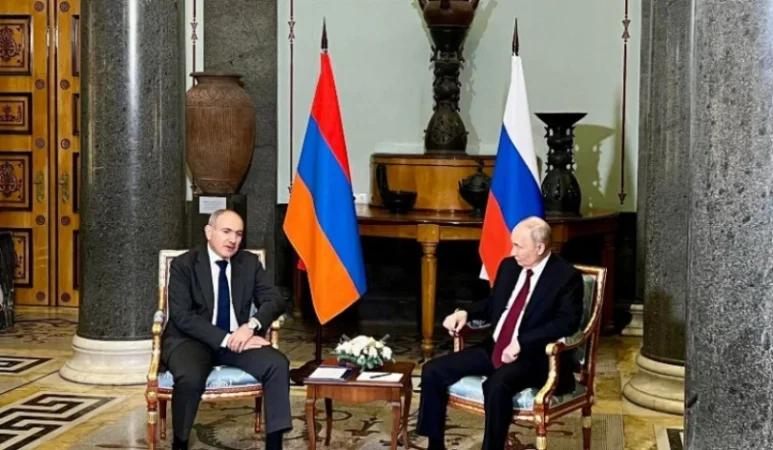

The implementation of the scenarios outlined in the first part will also depend on the course of the Russia–Ukraine war. A significant weakening of Russia would force Moscow to pursue a more cautious policy toward Armenia. A substantial share of Armenia–Russia trade continues to be linked to Russian parallel import and export schemes, meaning that a degree of dependence also exists on the Russian side. This helps explain why Russia’s restrictions on Armenia have so far remained relatively limited. For example, in the case of fruit and vegetables, seasonality is a significant factor, particularly during the summer–autumn period; in other cases, restrictions have been confined to specific sectors—for instance, the ban applies only to certain types of alcoholic products rather than to the sector as a whole. Under these circumstances, Armenia’s response could have a significant impact on Russia’s further course action. The current crisis in Armenian-Russian relations is rooted in Armenia’s continued strong economic dependence on Russia, a reality that is well understood both in Yerevan and Moscow. As Russia’s former military and political leverage has weakened, trade and economic ties, together with Armenia’s energy dependence, have become Moscow’s key instruments of pressure on Yerevan.
In this context, my main thesis is that reducing Armenia’s dependence on Russia could, rather than deepening the confrontation, contribute to the normalization of Armenian-Russian relations and their transition to a new model. Within this model, a clear distinction should be made between areas in which Armenia continues to take Russia’s interests into account and those in which a revision of the existing relationship is unavoidable. The former may include the presence of the Russian military base (until 2044, under the 2010 agreement) and the maintenance of economic relations. The latter may include the presence of Russian border guards along Armenia’s borders with Iran and Turkey, the cancellation of the railway concession, and abandoning the existing mechanisms for interfering in Armenia’s domestic affairs. In this situation, the most risky option for Armenia could be to make partial concessions to Russia without first clearly establishing a new model of relations, with the aim of avoiding a further escalation of the current confrontation. Such a policy, however, carries the risk of undermining the EU’s trust in Armenia. This model can be described as the “partial concession trap.” It refers to a form of asymmetric relations in which the weaker side responds to pressure from the stronger partner through limited concessions, seeking to reduce the intensity of that pressure while simultaneously maintaining alternative external ties, in this case with the EU and the United States.
However, each such concession confirms the effectiveness of coercion and, consequently, creates an incentive to use it again. At the same time, alternative partners begin to question the stability of the weaker side’s foreign policy course. In Armenia’s case, the parallel with the “September 3, 2013 scenario” is evident. As a result, the scope for foreign policy maneuvering is not expanded but narrowed: dependence on the source of pressure remains, while alternative partners become less willing to invest resources in helping overcome that dependence. Thus, making partial concessions to Russia could have a dual negative effect for Armenia. On the one
hand, it demonstrates to Moscow the effectiveness of economic and political pressure; on the other, it undermines the EU’s confidence in the stability of Yerevan’s European course. As a result, the attempt to maintain relations with both Russia and the EU simultaneously could produce the opposite outcome: the perpetuation of dependence on Russia and the gradual weakening of European support. For Brussels, the issue concerns not only Yerevan’s choice today, but also Armenia’s strategic reliability as a partner. The experience of 2013 created a historical precedent in which the years-long process of rapprochement with the EU became reversible under the impact of Russian pressure. Therefore, new concessions to Moscow could be perceived not merely as an isolated tactical move, but also as a possible reproduction of a model in which Russia can influence Armenia’s strategic decisions through pressure. It is precisely for this reason that my proposal is based on two interrelated principles: clearly defining the “red lines” in relations with Russia and developing a deeper partnership with the EU. What does a deeper partnership entail?
It is a model of relations within which Armenia and the EU acknowledge a fundamental convergence of their strategic interests. At the same time, this does not necessarily imply public confrontation with Russia. Instead, the parties proceed from the possibility of further Russian pressure, jointly identify its potential instruments in advance, and establish mechanisms that would allow them to neutralize those instruments or minimize their consequences before they are deployed. In other words, Armenia and the EU should not merely respond to Russian pressure once it has already been exerted; they should also anticipate Russia’s next moves and develop policies for responding to them.
t is not necessary for the most sensitive aspects of such coordination to be carried out in a public format. The EU should have a comprehensive understanding of Armenia’s most vulnerable areas and, together with Yerevan, establish in advance economic, energy, infrastructure, and institutional safeguards. The purpose of such a policy should be to gradually reduce the effectiveness of Russia’s instruments of pressure and, consequently, diminish Moscow’s incentive to use them. Another important avenue for strengthening the resilience of the countries of the South Caucasus is the establishment of predictable and mutually acceptable mechanisms for regional cooperation and mutual assistance. As noted above, since May 2026, there has been a shift in Tbilisi’s position toward Russia, which had taken shape over the previous four years.
At the same time, tensions in Russian-Azerbaijani relations persist, despite repeated statements about the normalization of relations following the crash of the AZAL aircraft. All of this increases the need to develop common regional approaches and principles on key areas of interaction, including relations with Russia. The establishment of such a platform could also contribute to the normalization of Georgia’s relations with the EU and the United States, particularly given that, in parallel with the Armenian-Azerbaijani normalization process, relations between Armenia and Azerbaijan and their Western partners are improving. Conclusions Armenian-Russian relations continue the fundamental transformation that began in 2022–2023, accompanied by a gradual reduction in Armenia’s dependence on Russia and the diversification of its relations with other international partners, first and foremost the EU and the United States. An important component of this process is the Armenian-Azerbaijani normalization process, which weakens one of the key mechanisms of Armenia’s external dependence while
simultaneously creating new opportunities for regional cooperation. Amid Russia’s ongoing trade and economic pressure, the principal recommendation is to strengthen the mechanisms of Armenia-EU cooperation, establish a deeper partnership with the EU, clearly define the “red lines” in relations with Russia, and develop a new model of Armenian-Russian relations. This policy should be accompanied by stronger regional cooperation, including the establishment of mechanisms for mutual support among the countries of the South Caucasus in the face of risks emanating from Russia.
Samvel Meliksetyan
This article was produced by the Armenian Council Research Center with the support of the Yerevan Office of the Friedrich Naumann Foundation for Freedom in the South Caucasus. The views and opinions expressed in this article do not necessarily reflect those of the Friedrich Naumann Foundation for Freedom or its staff.