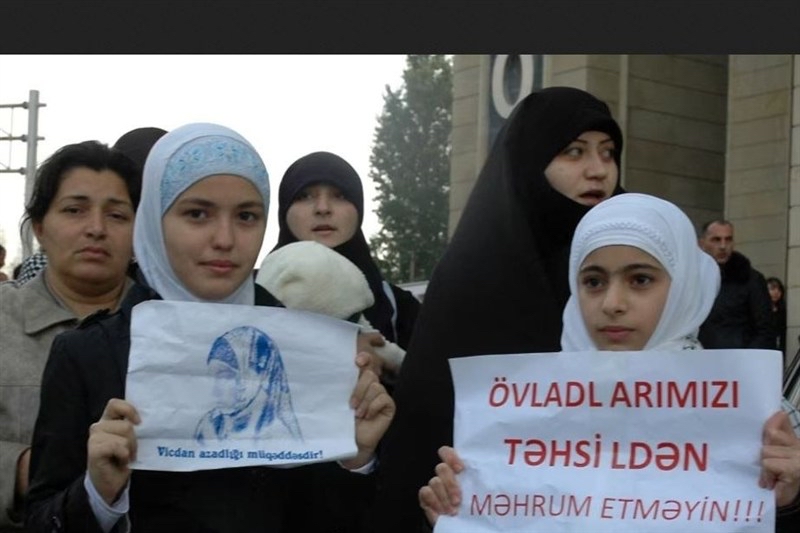

Debates and confrontations over religious attire, particularly the hijab, in Azerbaijan’s general education system have a history spanning more than a decade and a half. In the Azerbaijani authorities’ policy, preserving secularism is often framed as a cornerstone of state security and a means of countering external influence, particularly from Iran. Yet this policy, enforced through heavy-handed administrative measures, repeatedly encounters resistance from conservative segments of the country’s Shia Muslim population, triggering profound legal, social, and political crises.
1. The Outbreak of the Hijab Crisis and Its Historical Context
The first major wave of state-imposed restrictions on wearing the hijab in schools began in the autumn of 2010. Azerbaijan’s then Minister of Education, Misir Mardanov, announced that pupils in all general education institutions across the country were required to wear uniforms. This decision effectively banned the hijab in schools, provoking widespread discontent among religious citizens. Protests broke out in various parts of the country in response to the ministry’s decision. In December 2010 and May 2011, unprecedented demonstrations involving thousands of people took place outside the Ministry of Education in Baku. Taking to the streets under the slogan “Freedom for the Hijab,” protesters demanded that the restrictions be lifted. The demonstrations escalated into clashes with police, during which dozens of activists and religious figures were arrested.
Protests quickly spread to Ganja, Masalli, Astara, and the settlement of Nardaran, known for its deeply conservative population. Security forces forcibly dispersed the gatherings, arresting hundreds of participants.
During another major protest in Baku in October 2012, more than 60 demonstrators were arrested. Human rights defenders described the detained religious activists and clerics as “hijab prisoners.” Faced with widespread public resistance amid mass repression, the authorities were compelled to ease enforcement temporarily in 2012, but the issue remained unresolved at a systemic level.
2. The Nardaran Factor and the Politicisation of Shia Resistance
The settlement of Nardaran has played a pivotal role in opposing the hijab ban and, more broadly, in preserving Azerbaijan’s Shia identity. An ancient pilgrimage site, it has traditionally been known for its population’s strong religiosity and pro-Iranian sentiments.
Nardaran became a symbol of religious resistance to the authorities. This confrontation culminated on 25–26 November 2015, when Azerbaijani security forces carried out a special operation against the Muslim Unity Movement, leaving seven people dead, including two police officers, and more than 70 under arrest.
3. A New Wave of the Hijab Crisis in 2026
The policy of restricting the hijab, which began in 2010, gained renewed momentum in September 2026, although the decision had been adopted in July without public consultation. Azerbaijani Government Decision No. 309 of 21 September introduced new uniform requirements for pupils in general education institutions. Although the document does not mention the word “hijab,” it prohibits items of clothing that depart from the prescribed uniform or are “incompatible with the principle of secularism.”
Following the adoption of this decision, widespread cases of female pupils and teachers being denied entry to schools were reported across the country:
- Sumgayit, Ganja, Sabirabad, and Imishli: Citing “instructions from above,” headteachers at several schools in these cities and districts required female pupils to remove their headscarves or leave school.
- Restrictions on rights and arrests: Many girls have been denied access to education. Religious figures who opposed the hijab restrictions, including theologian Abgul Suleymanov, have been placed in administrative detention.
- International reaction: The school hijab ban has drawn attention beyond Azerbaijan, provoking discontent among religious and civil society organisations in Turkey. Numerous protests directed against Azerbaijan are being held in Ankara and Istanbul.
Conclusion
Azerbaijan’s Constitution guarantees the right to education and freedom of conscience and religion, while also establishing the secular character of the state. In practice, administrative measures taken under the pretext of preserving secularism violate citizens’ fundamental rights. Developments since 2010 show that the school hijab ban and broader measures aimed at silencing radical Islam form part of a single state policy. The Azerbaijani authorities seek to prevent any independent religious or social organising that could develop into political opposition, since adherents of radical Islam have consistently posed a greater threat to them than conventional opposition groups. Such heavy-handed policies, however, do not resolve the problem. Instead, they drive it beneath the surface, sustaining social tensions and the risk of further clashes.
Diana Karapetyan
Sources
- Dövlət ümumi təhsil müəssisəsi təhsilalanlarının geyim formalarının təsvirləri [Descriptions of School Uniforms for Pupils in State General Education Institutions] https://e-qanun.az/framework/49312
- Azerbaijan: Torture and travesty of justice in Nardaran case https://www.amnesty.org/en/documents/eur55/5633/2017/en/
- Azerbaijan students launch school strike over hijab restrictions https://oc-media.org/azerbaijan-students-launch-school-strike-over-hijab-restrictions/
- Azerbaijan and Turkey spar over hijab ban https://eurasianet.org/azerbaijan-and-turkey-spar-over-hijab-ban
- Azerbaijan hijab ban: Can a Secular State Bar Girls From School? https://www.diplomacyandlaw.com/post/azerbaijan-hijab-ban
This article was produced by the Armenian Council Research Center with the support of the Yerevan Office of the Friedrich Naumann Foundation for Freedom’s South Caucasus regional programme.
The opinions and positions expressed in this article do not necessarily reflect the views of the Friedrich Naumann Foundation for Freedom or its staff.