
The Mecca Agreement and the New Balance of Power in the Middle East
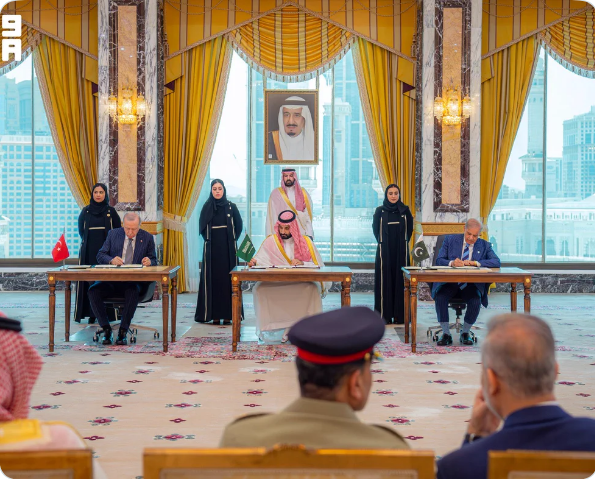
The wider Middle East has entered a phase of shifting power dynamics. On August 7, Saudi Arabia, Türkiye, and Pakistan signed the “Mecca Joint Defence Agreement,” stipulating that an armed attack against any one of the three countries would be regarded as an attack against all three. At first glance, this provision resembles Article 5 of the North Atlantic Treaty, but the purpose of the new agreement is not to create an “Islamic NATO”; rather, it is to gradually redistribute responsibility for security in the region.
The Mecca Defence Agreement
The Mecca Agreement does not yet create an integrated military alliance along the lines of NATO. It does not provide for a unified command, permanent joint forces, or an automatic mechanism for military intervention in the event of aggression. Moreover, it remains unclear what form the other two countries would provide in practice if any one of the three were attacked—troops, air or missile defence, intelligence, arms and logistical support, or some combination thereof.
The agreement provides only for the establishment of political and military coordination mechanisms, involving the defence and foreign ministers, as well as military commanders. It also creates an opportunity to conduct joint military exercises and deepen cooperation in the defence industry.
Notably, the Mecca Agreement is not the result of a single day or meeting. It was preceded by nearly two years of discussions, while in 2025 Saudi Arabia and Pakistan had already signed a bilateral defence agreement. In other words, what we are witnessing is a gradually deepening security partnership.
NATO’s experience demonstrates that an effective military alliance is built not only through political declarations, but also through command, financial, technical, and operational mechanisms developed over years. In the case of the Mecca Agreement, it is precisely the pace and depth of this institutionalisation that will serve as the key indicators of its consolidation.
Why Now?
The timing of the agreement’s signing is not accidental. The Middle East’s previous security balance has changed significantly in recent years. Regional wars, missile and drone attacks, instability around the Strait of Hormuz and the Red Sea, as well as the confrontation between the United States and Israel and Iran, have demonstrated that traditional security guarantees are no longer sufficient for all regional actors.
Under these circumstances, a new logic is emerging: regional countries are not abandoning cooperation with external powers, but at the same time are seeking to develop their own security capabilities and establish mutual guarantees.
In this sense, the Mecca Agreement is part of a broader process—the decentralization of security in the Middle East. In recent years, various multilateral formats have been emerging and deepening across the region. Particularly noteworthy is the trilateral cooperation among Israel, Greece, and Cyprus, which has recently expanded into the areas of security, defence, maritime security, and energy. In December 2025, the three countries agreed to deepen their defence and military cooperation, while a joint action plan was signed for 2026.
These formats are not yet conventional military alliances, but they demonstrate that states in the region are seeking to build interconnected yet distinct networks of security and strategic partnerships—responding to common threats while simultaneously strengthening their own strategic autonomy.
What Do the Parties to the Mecca Agreement Gain?
For Riyadh, one of the agreement’s key objectives is deterrence. The Houthi attacks have demonstrated the vulnerability of Saudi Arabia’s oil and strategic infrastructure. Consequently, establishing additional security guarantees is a natural priority.
Cooperation with Türkiye enables Saudi Arabia to further deepen its ties with one of the region’s leading defence-industrial powers, while Pakistan’s involvement adds a strategic deterrence component.
Thus, within the framework of the agreement, Saudi Arabia provides financial resources, a market, and geopolitical weight, while in return gaining additional military and strategic capabilities.
However, Riyadh also has a broader objective: reducing its dependence on a single security umbrella without abandoning that umbrella altogether.
For Ankara, the agreement represents another opportunity to establish an independent strategic pole in the Middle East. Türkiye has accumulated considerable military and institutional experience within NATO, possesses a developed defence industry, and has broader regional ambitions.
In this context, Türkiye’s defence industry could become an important economic beneficiary of the agreement. The Saudi market is already an important destination for Türkiye, while deeper defence cooperation could further expand the scale of these ties.
At the same time, if the agreement eventually evolves into a more binding military alliance, Ankara will face an important strategic question: how to reconcile its new security commitments with its NATO membership and obligations within the alliance.
For Islamabad, the agreement provides an opportunity to strengthen its position as a regional security actor and deepen its relations with Saudi Arabia and the Gulf states.
Pakistan’s involvement also has particular strategic significance given the country’s military capabilities and nuclear arsenal. At the same time, Islamabad is keen to ensure that the agreement is not perceived as an alliance directed against any particular country, such as neighbouring Iran. Pakistan’s Foreign Minister Ishaq Dar has described it as “purely defensive” and stressed that it is not directed against any country.
This approach is important because the agreement’s sustainability will depend to a large extent on its ability to preserve flexibility without evolving into an overt politico-military bloc directed against a particular adversary.
Who Is It Intended to Deter?
Following the signing of the Mecca Agreement, the most widely debated questions are who and what actions it is intended to deter.
The first factor is Iran and armed groups affiliated with Iran. Previous attacks against Saudi Arabia, competition with Tehran, and changes in the security environment in the Persian Gulf give the agreement a potential deterrence component vis-à-vis Iran.
The second is Israel’s regional military dominance. Israel’s military operations and the resulting shifts in the regional balance of power have heightened security concerns among a number of Muslim states. This factor is particularly sensitive for Türkiye and Pakistan.
Thus, the agreement is officially neither anti-Iranian nor anti-Israeli. However, its formation could create additional deterrence potential against both Iran and Israel’s regional influence.
It is important, however, to distinguish between a political message and a military commitment. The three countries’ shared interests are sufficient to deepen security cooperation, but this does not necessarily mean that they are prepared to adopt a common position in response to every regional crisis.
The Mecca Agreement and the United States
Another important component of the Mecca Agreement is the aspiration to gradually reduce dependence on the US security umbrella.
This does not mean that Türkiye, Saudi Arabia, and Pakistan are preparing to sever their relations with Washington. All three countries continue to cooperate with the United States at various levels. The objective is not to replace the United States, but rather to diversify sources of security.
The Mecca Agreement is not at odds with US regional interests; Donald Trump has already welcomed the signing of the defence pact.
What Will the Agreement’s Success Depend On?
It is still too early to call the Mecca Agreement a “Middle Eastern” or “Islamic NATO.” The initiative’s prospects will depend on the practical steps taken in the coming period, including the establishment of permanent military coordination mechanisms, joint military exercises, deeper intelligence and defence cooperation, and the parties’ actions in the event of an actual crisis.
The inclusion of new members will also be an important indicator. If the format expands, it could evolve into a broader regional security platform. In this context, Egypt is being considered as a potential candidate. The Turkish President has already stated that Cairo could join the agreement, while Egypt has emphasized the need to examine its legal and constitutional implications. Egypt’s involvement would significantly increase the pact’s geopolitical weight, but at the same time make it more difficult to reconcile the parties’ common security priorities.
Conclusion
The Mecca Agreement does not yet entail the creation of a military alliance, but its political significance should not be underestimated. It demonstrates that a new security logic is emerging in the Middle East, in which states are seeking not only to benefit from guarantees provided by external powers, but also to establish their own mechanisms of mutual security.
If, in the coming years, the agreement develops into genuine military coordination, joint capabilities are further strengthened, and its membership expands, it could become an important institutional foundation for the gradual localization of security responsibility in the region and the emergence of new centres of power.
Narek Minasyan
This article was produced by the Armenian Council Research Center, with the support of the Yerevan office of the Friedrich Naumann Foundation for Freedom for the South Caucasus region.
The views and positions expressed in this article do not necessarily reflect those of the Friedrich Naumann Foundation for Freedom or its staff.