
Introduction
This paper examines the results of the National Assembly elections held on June 7, 2026, their significance and interpretation, as well as the forecasts made prior to the vote, assessing their accuracy. It also outlines the existing legal framework governing the electoral process and examines the possible implications of the forthcoming decision of the Constitutional Court and its potential impact on Armenia’s political landscape.
Election Results, Voter Turnout, and the Distribution of Parliamentary Mandates
By its decisioni of June 14, the Central Electoral Commission finalized the official election results. It is noteworthy that, prior to doing so, the CEC had, on its own initiative and following an internal review, invalidated the results from three polling stations.
At two of the invalidated polling stations, voting had continued after 8:00 p.m., while at the third, one participant’s ballot paper had been unavailable until 6:00 p.m. In essence, these irregularities constituted sufficient factual grounds for invalidating the results at all three polling stations.
At the same time, given the Prosperous Armenia Party’s borderline position with respect to surpassing the 4% electoral threshold required for parliamentary representation, there was a widespread expectation among the public and other stakeholders that repeat voting would be held at those three polling stations.
Nevertheless, rather than ordering repeat voting, the Central Electoral Commission adopted the aforementioned decision finalizing the results.
Before examining this approach in greater detail, it is useful first to consider the overall electoral outcome reflected in the Commission’s decision, as well as the forecasts made prior to the elections.
Forecast: Voter turnout, measured as a percentage, would be higher than in the previous two parliamentary elections.
This forecast proved accurate. Moreover, not only was turnout higher in percentage terms, but the absolute number of voters who participated in the election was also significantly greater than in either of the two preceding parliamentary elections.
| Election | Number of Participants | Number of Registered Voters | Voter Turnout (%) |
| 2018 | 1,261,105 | 2,593,140 | 48.6 |
| 2021 | 1,281,997 | 2,595,512 | 49.3 |
| 2026 | 1,476,769 | 2,503,990 | 58.9 |
The table makes it possible to compare the elections and observe the dynamics of voter turnout.
Several factors may explain the higher turnout recorded in these elections. First, the previous two parliamentary elections were snap elections, leaving participants with considerably less time to prepare and campaign. In contrast, although the official campaign period for these elections lasted one month, campaigning had, in practice, begun much earlier—at least six months before election day. This extended campaign enabled political contestants to maximize the mobilization of the public, their supporters, and potential voters, effectively keeping society engaged in the electoral process for nearly half a year.
During the official campaign period alone, participants spent more than AMD 2 billion. Notably, however, three political forces—the Civil Contract party, Strong Armenia, and the Armenia Alliance—accounted for approximately 75% of total campaign expenditures. If Prosperous Armenia and the Wings of Unity alliance are also included, five of the eighteen participating electoral contestants were responsible for nearly 90% of all campaign spending.
Other important, albeit less explicit, factors contributing to the high turnout were the highly competitive nature of the election, the absence of a predetermined outcome, and the relatively high level of public confidence in the electoral process.
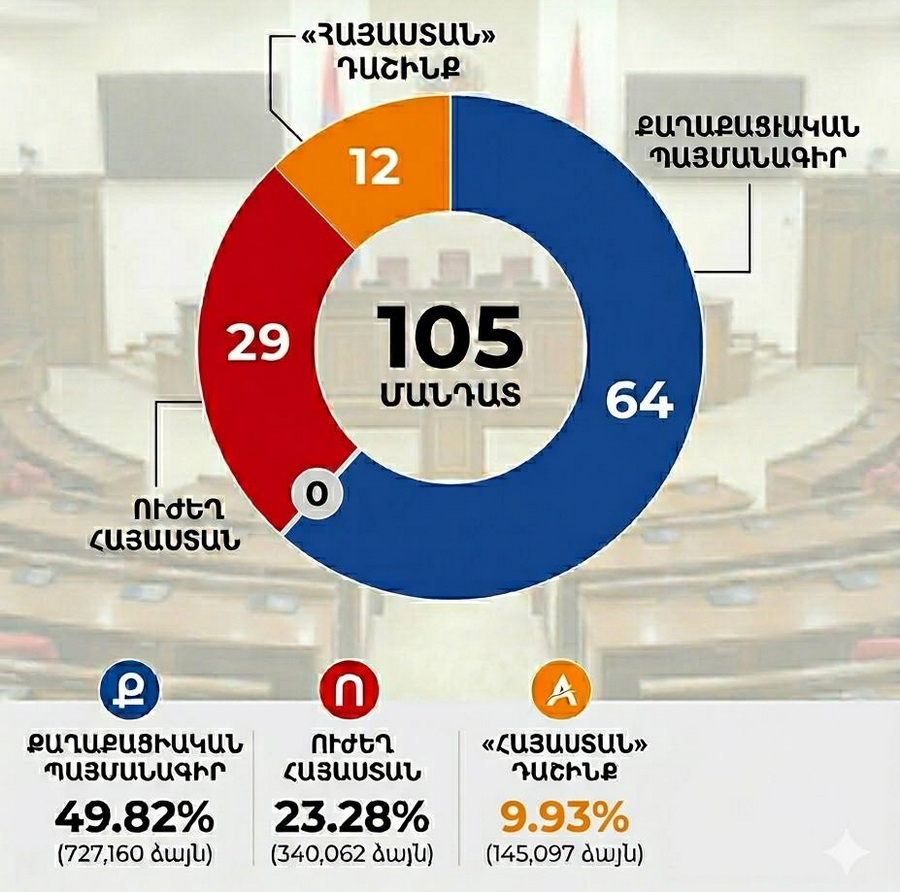
As a result of the election, three political forces secured representation in the National Assembly:
- Civil Contract – 64 seats
- Strong Armenia – 29 seats
- Armenia Alliance – 12 seats
Let us now turn to the remaining pre-election forecasts.
Forecast: Fewer electoral alliances would participate in the election.
Forecast: A second round of voting would not be required.
Forecast: No political force would secure a constitutional majority.
The three forecasts outlined above also proved accurate. Of the 19 political forces initially registered to contest the elections (the Alliance Party withdrew its candidacy during the pre-election period and exited the race), only two were electoral alliances (approximately 11%).
This forecast was based on the relatively high electoral threshold established for alliances. Interestingly, both alliances ultimately succeeded in surpassing the electoral threshold. It should be noted that, because the threshold for alliances is higher than that for individual parties, political forces are generally more cautious about contesting elections as alliances and tend to do so only when they have a reasonably high likelihood of securing parliamentary representation.
By combining the pre-election polling data and the broader political context with the electoral rules, it was possible to anticipate that a second round of voting would not be necessary. The leading contender, Civil Contract, was expected to secure a parliamentary majority through the existing seat-allocation mechanism, enabling it to form a government on its own.
At the same time, this was not expected to be sufficient for the party to obtain a constitutional majority—that is, two-thirds of the seats in the National Assembly (70 seats). Nevertheless, 64 seats constitute more than three-fifths of the legislature, meaning that the governing party will be able to appoint, on its own, members of several constitutional bodies and holders of certain constitutional offices. It will also be able to adopt constitutional laws independently, including, for example, the Electoral Code, the Law on Political Parties, and the Law on the Constitutional Court.
The CEC’s Decision and Its Potential Consequences
Before examining in detail the Central Electoral Commission’s decision to finalize the election results without ordering repeat voting at the three invalidated polling stations, it is appropriate to consider the forecasts that did not materialize.
Forecast: Prosperous Armenia would enter parliament.
Forecast: More political forces would secure parliamentary representation.
The CEC’s decision not to hold repeat voting at the three polling stations whose results had been invalidated ultimately resolved Prosperous Armenia’s borderline electoral position in favor of its exclusion from parliament.
The party fell short of the electoral threshold by approximately 150 votes, while a total of 3,411 voters had cast ballots at the three invalidated polling stations. Had Prosperous Armenia entered parliament, the distribution of seats would have been as follows:
- Civil Contract – 61 seats
- Strong Armenia – 28 seats
- Armenia Alliance – 11 seats
- Prosperous Armenia – 5 seats
The Electoral Code provides that repeat voting shall be conducted at polling stations where results have been invalidated if the violations may have affected the election results and if the consequences of those violations can be remedied. In essence, the Code grants the Central Electoral Commission the authority to assess whether the identified irregularities were capable of influencing the outcome.
Nevertheless, from the standpoint of transparency, the CEC’s decision to finalize the election results without ordering repeat voting is, at the very least, open to questionii. The decision itself contains no reasoning explaining how the Commission concluded that the irregularities had not affected the election outcome.
The day after adopting its decision, the CEC issued a public statement arguing that holding repeat voting could have encouraged tactical voting, whereby voters would cast their ballots based on the preliminary electioniii results already known to them.
In support of this argument, the Commission referred to a report by the Venice Commission, which discusses the risks associated with tactical votingiv. However, the CEC did not cite the section of the same report noting that one possible way of addressing those risks is to conduct repeat voting nationwide rather than only at individual polling stations.
It is also important to note that the Venice Commission’s observations were not cited in the legal reasoning underlying the Commission’s decision itself.
Furthermore, it should be recognized that, by its very nature, the institution of repeat voting will almost always entail voters being aware of the preliminary electoral picture before casting their ballots again.
Conclusion
At present, it is known that seven of the eighteen electoral contestants have filed applications with the Constitutional Court, challenging the election results and seeking to have them declared invalid. Their appeals rely on various grounds, including allegations of vote buying, abuse of administrative resources, foreign interference, campaign finance violations, and other alleged irregularities.
Under the law, the Constitutional Court must issue its decision within 15 days. It may either uphold the election results or declare them invalid. In the latter case, two possible scenarios arise under the current legal framework: the complete invalidation of the election results or a revision of the allocation of parliamentary mandates.
The second scenario appears even less likely, as there appear to be no substantial or legally contestable issues concerning the calculation and distribution of parliamentary seats. Nevertheless, much will depend on the Constitutional Court’s interpretation of the relevant legal provisions.
Should the election results be declared invalid, a nationwide repeat vote must be scheduled within 15 to 30 days, as required by law.
Tigran Mughnetsyan
This article was produced by the Armenian Council Research Center with the support of the Yerevan Office of the Friedrich Naumann Foundation for Freedom in the South Caucasus.
The views and opinions expressed in this article do not necessarily reflect those of the Friedrich Naumann Foundation for Freedom or its staff.