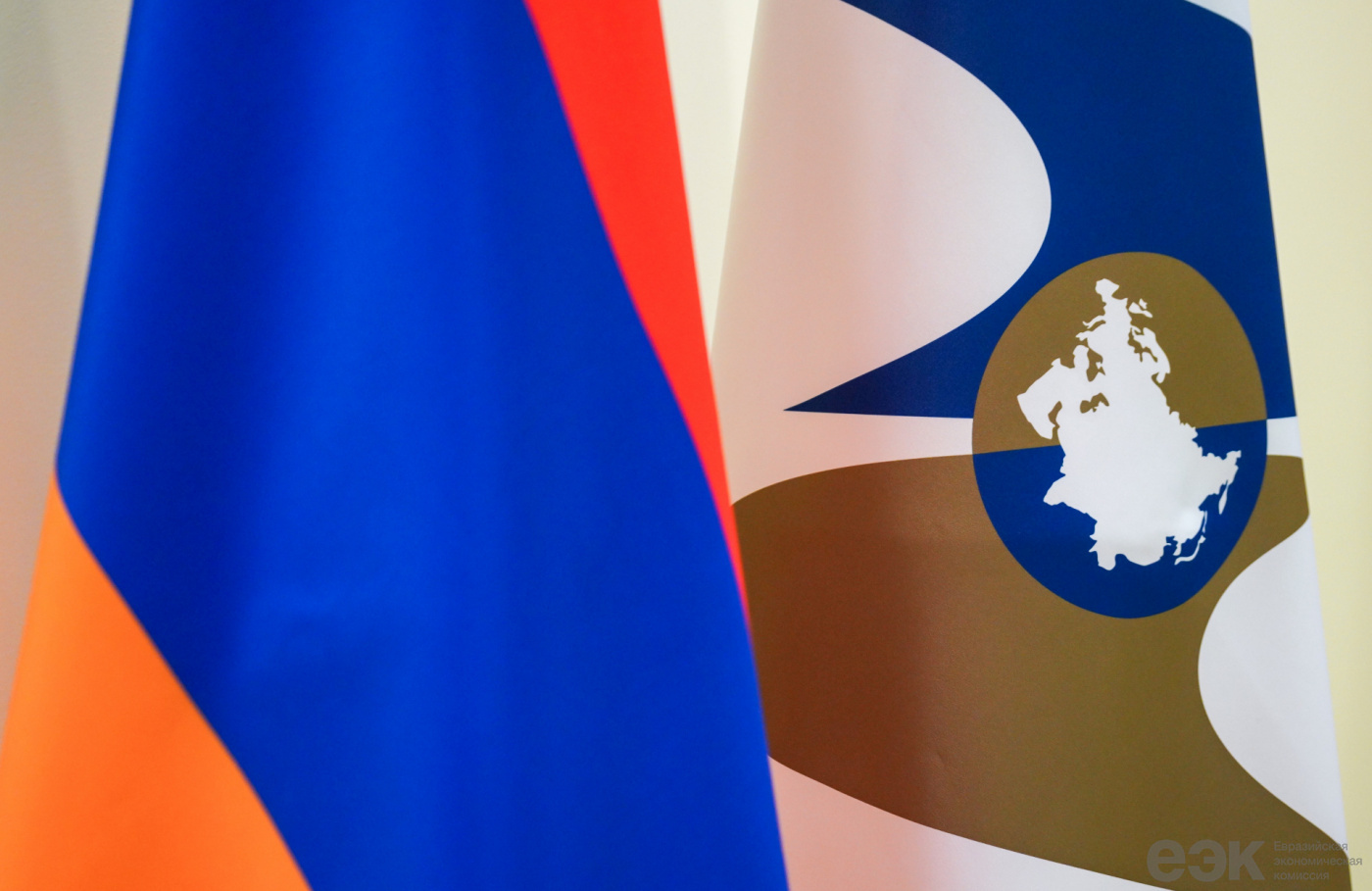

One of the central issues in Armenia’s political discourse today concerns the country’s membership in the Eurasian Economic Union (EAEU) and the future of its participation in the organization. Although this issue had existed for many years in a latent—or at least partially latent—form, it came sharply to the forefront only recently, when Russia began imposing restrictions on Armenian exports just weeks before the parliamentary elections.
Russia’s arbitrary application of sanitary and phytosanitary restrictions on animal-origin products imported from Armenia prompted renewed reflection on the very nature of the EAEU and on the advantages and disadvantages of Armenia’s membership in the organization. These developments have also made it necessary to consider potential alternatives in a more concrete and pragmatic manner. This article seeks to examine and analyze several practical aspects of this issue from the perspective of Armenia’s long-term economic development.
The EAEU was established as an economic integration organization intended to ensure the free movement of goods, services, labor, and capital among its member states. From the perspective of short-term economic interests, Armenia’s participation in the EAEU is undoubtedly of considerable importance. Membership enables Armenia to benefit from the Union’s free trade regime in its trade with other member states. At the same time, Armenia also enjoys the advantages of the EAEU’s common customs framework.
It is therefore no coincidence that Russia, itself an EAEU member state, has become Armenia’s principal trading partner. According to some estimates, Russia accounted for approximately 35 percent of Armenia’s exports in 2025, a figure equivalent to nearly 10 percent of Armenia’s gross domestic product (GDP). Admittedly, a substantial share of these exports consists of re-exports. This is attributable, on the one hand, to the existence of the EAEU’s common customs territory and, on the other, to the international sanctions imposed on Russia, which have enabled goods originating in third countries to enter the Russian market through Armenia without undergoing additional customs procedures within the Union.
Although the re-export factor is indeed significant, Russia has nevertheless become the principal export market for products genuinely manufactured in Armenia. Between 80 and 90 percent of Armenia’s exports of agricultural products, aquaculture products, processed agricultural goods, as well as alcoholic and non-alcoholic beverages, are destined for the Russian market. This level of market access is largely attributable to the EAEU’s free trade regime and would have been difficult, if not impossible, to achieve in its absence. Consequently, the loss of the Russian market would undoubtedly constitute a severe blow to Armenia’s economy in its current state.
Moreover—and this is of critical importance—Armenia imports the overwhelming majority of its energy resources from Russia. These supplies are provided at relatively preferential prices. This is of vital importance to Armenia and, at least formally, is again linked to the regulatory framework governing the EAEU. It is evident that any increase in the price of natural gas supplied by Russia would have a profoundly negative impact on Armenia’s economy as a whole, with serious social and economic consequences.
Taken together, these considerations are undoubtedly compelling. At present, EAEU membership provides Armenia with tangible and immediate economic benefits, while withdrawal would almost certainly generate significant short-term costs. Does this mean, however, that Armenia should remain
satisfied with its EAEU membership and abandon the search for alternative strategic options? In essence, such an approach cannot be regarded as rational for Armenia, for several reasons.
The fundamental issue is that participation in the EAEU does not provide the institutional foundations necessary for Armenia’s long-term and sustainable economic development. Armenia is now classified as an upper-middle-income country. With GDP per capita approaching US$9,000, the country is gradually reaching the stage at which the drivers of sustained economic growth become qualitatively different from those that proved effective when Armenia’s level of economic development was considerably lower.
According to the World Bank’s 2024 World Development Report, The Middle-Income Trap, democratic institutions become increasingly important—and ultimately decisive—for countries at this stage of development. International experience accumulated over several decades demonstrates that once countries reach this level of income, sustaining long-term economic growth becomes exceedingly difficult without democratic governance, particularly without the effective functioning of the rule of law, accountability mechanisms, and strong public institutions. This conclusion is supported by the development trajectories of both the countries of Central Europe and those of East Asia. Their experience also demonstrates that sustainable development is most successfully achieved when countries are economically integrated into the gravitational sphere of prosperous economies possessing strong and effective institutions.
The EAEU offers neither of these conditions. None of its member states can be regarded as a mature democracy, nor do they rank among the world’s leading economies. Russia—the dominant and agenda-setting power within the EAEU—lags considerably behind the world’s advanced economies in terms of GDP per capita. It occupies only a modest position in the global economy and international trade. Its share of global exports of high-technology products and, for example, digital services remains marginal.
As for democratic institutions, they are not among the EAEU’s defining priorities. Unlike the European Union, membership in the EAEU does not, in itself, promote the development or consolidation of democratic institutions. One of the underlying reasons is that the economies of the Union’s largest member states remain heavily dependent on the export of raw materials, a model that provides relatively weak incentives for the emergence of the efficient institutions needed to enhance productivity and foster innovation.
What Should Armenia Do?
The foregoing analysis suggests that although membership in the EAEU currently provides Armenia with important economic advantages, it is insufficient to create the conditions necessary for the country’s long-term sustainable development. It is therefore evident that Armenia must seek additional avenues for economic integration.
How can this be achieved?
First, Armenia should seek to defend its interests within the framework of EAEU law. This can be pursued through the EAEU’s principal bodies—the councils of heads of state and government, the Eurasian Economic Commission, the Commission’s Board (where Armenia is represented by two members), the Commission’s departments (five of the twenty-four departments are headed by Armenian nationals), and the Court of the Eurasian Economic Union (where Armenia has two of the eleven judges)—by resorting to the measures and procedures established under EAEU documents and regulations.
Second, Armenia should also actively seek new markets and find viable alternatives for its external economic relations. This can be pursued both through relations with countries in the immediate region—including neighboring states and Gulf countries—and through cooperation with European countries.
Third, Armenia’s region, including its immediate neighbors and adjacent countries, is rich in hydrocarbon resources; therefore, new sources of energy imports should be identified in order to substantially reduce dependence on supplies from the Russian Federation.
From a short-term perspective, these steps are indeed among the priorities. However, when it comes to a fundamental solution to the issue, the diversification of external markets, and the creation of an alternative framework for external economic relations, the best option is undoubtedly the European Union.
First, as recent developments and trends demonstrate, the European Union is interested in supporting Armenia’s efforts aimed at diversifying its external relations. A clear indication of this was the statement made by the President of the European Commission on 2 July 2026, according to which, following approval by the Council of the European Union and the European Parliament, 80 percent of Armenian goods—including 99 percent of agricultural products and 91 percent of beverages—would be able to enter the EU market without customs duties. This would constitute an unprecedented step, effectively establishing a unilateral free trade regime for Armenia while avoiding the risk of conflict with EAEU regulations.
In addition, Armenia already has a developed and multifaceted institutional foundation for cooperation with the European Union, centered around the Comprehensive and Enhanced Partnership Agreement (CEPA).
Finally, cooperation with the European Union provides all the instruments necessary to create favorable conditions for Armenia’s sustainable economic development. Cooperation with the EU corresponds to Armenia’s strategic and long-term economic development objectives. The EU’s economic gravitational pull possesses all the characteristics that make it attractive for economic development. The European Union brings together some of the world’s most economically and technologically advanced countries and is one of the largest actors in the global economy and international trade, surpassed only by the United States and China.
Most importantly, cooperation with the European Union contributes to the establishment of democratic and effective institutions, without which it is impossible to ensure Armenia’s sustainable development trajectory.
Hrachya Tashchyan
This article was produced by the Armenian Council Research Center with the support of the Yerevan Office of the Friedrich Naumann Foundation for Freedom in the South Caucasus.
The views and opinions expressed in this article do not necessarily reflect those of the Friedrich Naumann Foundation for Freedom or its staff