
In the run-up to Armenia’s parliamentary elections on June 7, 2026, Moscow paid unprecedented attention to virtually every major issue on Armenia’s domestic and foreign policy agenda. Official statements from Russia, expert commentary, and public discussions were marked by a remarkably consistent tone and recurring messaging.
One of the dominant themes in Russia’s information space was Armenia’s European trajectory. Within this broader discussion, one of the most prominent narratives was the call for the Armenian authorities to hold a nationwide referendum on the country’s prospective membership in the European Union.
Statements from Russia
Russian President Vladimir Putin first raised the issue of holding a referendum on EU membership on May 9, just one day after the official launch of Armenia’s election campaign. “Armenia should decide as soon as possible whether it intends to join the European Union or remain in the Eurasian Economic Union,” Putin statedi, while proposing that the matter be discussed at the upcoming Eurasian Economic Union summit held on May 29, which concluded with the adoption of a joint declarationii. The declaration stated:iii
“We share the position regarding the need to hold a nationwide referendum in the Republic of Armenia, as soon as possible, on whether the country should pursue membership in the European Union or remain within the Eurasian Economic Union.”iv
On May 29, Putin further stated:
“Prime Minister Pashinyan himself has said that he plans—and considers it appropriate—to hold a referendum on where Armenia should belongv: the Eurasian Economic Union or the European Union. We would ask that this be done as soon as possible.”vi
The issue was also raised by Sergey Shoigu on June 3:
“Behind that statement”—referring to the Armenian Prime Minister’s assertion that Armenia has not submitted an application for EU membership—”lies an obvious unwillingness to hold such a referendum. It is quite possible that the population would vote against it, forcing the current authorities in Yerevan into an uncomfortable conversation with their European patrons.”
On June 4, Russian Deputy Prime Minister Alexey Overchuk likewise argued:
“It would be better for Armenia to hold a referendum in the near future and determine whether it wishes to remain in the Eurasian Economic Union or join the European Union.”
The following day, Russian Foreign Minister Sergey Lavrov also called for such a referendum.
These official statements, reinforced by similar messaging from Russian experts, were accompanied by repeated claims that integration with the European Union would inevitably require Armenia to sever its ties with both the Eurasian Economic Union and Russia, ultimately leading to a severe economic crisis. Russian officials also maintained that “Russia will not finance Armenia’s rapprochement with the European Union.”
Throughout the election campaign, the issue of Armenia–EU relations remained highly prominent in Russian expert commentary and media coverage, where the rhetoric became increasingly confrontational. This information campaign coincided with restrictions imposed by Rosselkhoznadzor on the import of Armenian goods into the Russian market.
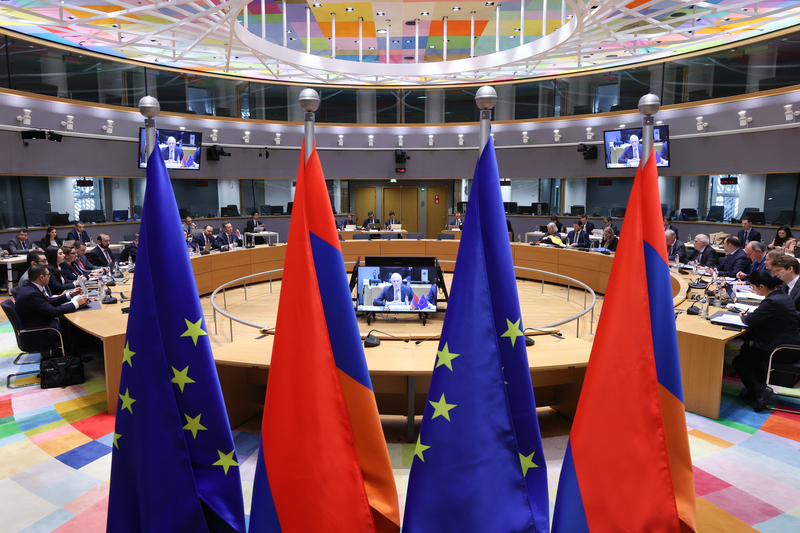
It is important to note that Armenia’s National Assembly had already adopted the Law on Launching the Process of Armenia’s Accession to the European Union in March 2025. However, Russia’s reaction during the following year was considerably less severe than the rhetoric observed during the election campaign. The renewed emphasis on the issue may also have been driven by the European Political Community Summit and the Armenia–European Union Summit, both held in Yerevan in early May 2026, during which Armenia and the EU achieved more tangible progress toward deepening their bilateral relationship.
The Referendum Process on European Union Membership
Unlike many international organizations in which member states possess veto power, many decisions within the European Union are adopted by qualified majority voting. This means that a member state is required to comply with adopted legislation even if it voted against it. At the same time, EU law takes precedence over the national legislation of member states. If domestic legislation conflicts with EU law, the latter prevails.
In the case of accession to an international organization of this nature, the Constitution of the Republic of Armenia indeed provides for the holding of a referendum under Article 205vii. In this context, however, the key issue is not whether a referendum should be held, but rather when it should take place.
EU law does not require a candidate country to hold a referendum on accession. Instead, an accession treaty is concluded with the candidate state, after which it must be ratified by all EU member states as well as by the candidate country itself. Whether a referendum is held is governed by the candidate state’s own constitutional and legal framework. At the same time, there is a well-established international practice and rationale for conducting such referendums at the final stage of the accession process rather than at its outset.
The EU accession process itself generally follows a clear sequence of steps: submitting an application; obtaining candidate status with the unanimous approval of all 27 member states; negotiating and aligning national legislation with the EU acquis across 35 negotiating chapters;
concluding the negotiations and signing the Accession Treaty; and finally, ratification. Accordingly, referendums are typically held to determine whether the citizens of the candidate country approve the ratification of the accession treaty concluded with the European Union.
Beyond the legal procedures, there are also economic, political, and practical reasons why referendums are generally reserved for the final stage of the accession process. By that point, citizens of the candidate country have a much clearer understanding of both the potential benefits and the possible costs of EU membership. There is also greater certainty regarding implementation timelines—for example, whether and when the country would adopt the euro, the availability of EU subsidies, transitional arrangements, and other key aspects of accession.
Political considerations are equally important. By the final stage of what is often a process lasting many years, there is a much clearer picture of the European Union’s enlargement policy, the positions of the member states, and the state of relations between the EU and the candidate country. Holding a referendum at this point therefore significantly reduces political uncertainty.
Conversely, holding a referendum at the outset of the process may leave a country more vulnerable to external pressure. Having publicly declared a strategic choice while not yet benefiting from the European Union’s economic or security umbrella, the candidate state may face increased external risks. There is also an important domestic political consideration. When a referendum is held at the final stage, society has had sufficient time to prepare for the prospect of EU membership, public opinion has had the opportunity to evolve, and the accession process is more likely to be perceived as a national project rather than the agenda of the political force in power at a particular moment.
Among the European Union’s current member states, fifteen held conventional referendums on EU accession. In every case, the referendum took place at the final stage of the accession process—either after the accession treaty had been signed or during the ratification process. For example, during the EU’s largest enlargement in 2004, the Accession Treaty with the candidate countries was signed on April 16, 2003. Malta and Slovenia held their referendums in March 2003, Hungary in April 2003, while the remaining candidate countries conducted theirs at later dates. Norway provides another illustrative example: it held referendums on EU membership twice—in 1972 and again in 1994—and on both occasions voters rejected the accession treatyviii.
There are also several current EU candidate countries that have not yet held referendums on accession, including Albania, Montenegro, Serbia, North Macedonia, Ukraine, Bosnia and Herzegovina, and Türkiye. Türkiye’s experience is particularly instructive in demonstrating why holding a referendum at the outset of the accession process is generally inadvisable. Although Türkiye officially obtained candidate status in 1999, had a referendum been held 20 or 30 years ago, its outcome would by now have lost its practical and political relevance.
To some extent, Moldova represents an exception. It obtained EU candidate status on June 23, 2022, while the formal opening of accession negotiations was announced only recently, in June 2026. Nevertheless, Moldova held a referendum in 2024. It should be emphasized, however, that this was not a conventional referendum on EU accession. Rather, it concerned constitutional amendments aimed at enshrining European integration as the country’s “irreversible objective.” Similarly, Georgia’s Constitution also enshrines the country’s aspiration to integrate into both the European Union and NATO, yet Tbilisi has not held a referendum on EU membership.
Moscow’s Objective and Yerevan’s Position
Since the European Union does not prescribe when a referendum should be held, Moscow’s call for Armenia to organize one at the very beginning of the accession process can be viewed as a political calculation driven by several underlying considerations.
Armenia has not yet even submitted an application for EU membership. Unlike Georgia, Ukraine, and Moldova, it does not have an Association Agreement with the European Union, nor is it part of the EU Customs Union. Consequently, at this stage there are, in practical terms, no legal or technical obstacles arising from Armenia’s relations with Russia or from the incompatibility between the European Union and the Eurasian Economic Union.
Theoretically, if Armenia were to hold a referendum now and the public voted against EU membership, the accession process would effectively come to an end. Such an outcome would represent a major foreign policy setback for the current government and would deal a significant blow to its broader strategy of foreign policy diversification.
Conversely, if the referendum resulted in a “yes” vote, Russia would acquire a strong pretext for imposing severe economic and political measures against Armenia, including raising natural gas prices, restricting exports, and limiting the free movement of capital, labor, and services. As a result, Armenian society could begin experiencing the perceived “costs” of EU accession before the accession process had even formally begun.
Such a scenario could, in turn, fuel public disappointment and polarization, trigger economic disruption, and reinforce a climate of uncertainty and fear. Consequently, public support for Armenia’s European integration could decline, reducing electoral support for pro-European political forces in future elections.
For Russia, it is also important to prevent Armenia’s economy from moving closer to Western markets, as this would gradually reduce Armenia’s existing economic dependence on Russia. Moreover, closer integration with the European Union would require the modernization of Armenia’s legal and institutional framework in line with European standards, thereby weakening Moscow’s traditional instruments of influence.
Accelerating the referendum could also hasten a legal and political collision between Armenia’s obligations within the Eurasian Economic Union and its prospective European trajectory, exposing the country to significant economic turbulence.
From a geopolitical perspective, Moscow’s concerns are understandable to some extent. No current EU member state or candidate country has ever simultaneously been a member of the Eurasian Economic Union. In this respect, Armenia represents a unique case.
Yerevan’s approach to relations with the European Union reflects a pragmatic calculation. Recognizing that it cannot guarantee either the future direction of EU enlargement policy or the eventual success of accession negotiations—and taking into account Armenia’s substantial economic and energy dependence on Russia—the Armenian government has sought to avoid abrupt geopolitical realignment.
Instead, it has opted for a strategy of gradual diversification. This approach frames closer cooperation with the European Union not as a sudden rupture with Russia, but rather as a means of modernizing Armenia’s institutions and economy.
Conclusion
Both the formal process of accession to the European Union and any referendum associated with it should therefore be understood not as matters requiring haste, but as sovereign, long-term strategic decisions.
A referendum is most appropriate—and most effective—once the accession process has reached a stage where its legal and technical parameters are sufficiently clear and the associated risks are more manageable.
Over the coming years, it will be essential for Armenia to maintain a realistic assessment of its opportunities in order to avoid creating unrealistic public expectations and the disappointment that could follow. Decisions of this magnitude should be guided exclusively by the long-term interests of Armenia’s citizens and grounded in careful security and economic assessments.
Varduhi Harutyunyan
i https://www.kommersant.ru/doc/8652922
ii http://kremlin.ru/supplement/6497
iii https://www.interfax.ru/russia/1092737
iv https://www.interfax.ru/russia/1093652
v https://ria.ru/20260604/eaes-2096668047.html
vi https://iz.ru/2109582/tatiana-baikova/dostizhenie-tcelei-svo-ukrepit-nashi-pozicii-na-mezhdunarodnoj-arene
vii https://old.arlis.am/DocumentView.aspx?docID=102510
viiihttps://european-union.europa.eu/principles-countries-history/history-eu_en?utm_source=chatgpt.com
This article was produced by the Armenian Council research center with the support of the Yerevan office of the Friedrich Naumann Foundation for Freedom in the South Caucasus region.
The views and opinions expressed in this article do not necessarily reflect those of the Friedrich Naumann Foundation for Freedom or its staff.