
When Ukrainian President Volodymyr Zelenskyy demanded that Belarus disconnect the equipment used to relay Russian drone signals—warning that Ukraine would do so itself if Belarus failed to act—many awaited President Alexander Lukashenko’s response with great interest. Days later, Zelenskyy announced that the equipment had indeed been disconnected, a development that was immediately followed by Lukashenko’s visit to Moscow. At the same time, the Russian foreign minister warned Ukraine that Russia would “defend” Belarus “by every possible means” should it come under attack.
Nevertheless, Ukraine appears satisfied, while no further reactions have emerged from Moscow. Instead, a far more intriguing development has unfolded. On June 26, Lukashenko traveled to Moscow and, the following day, after accompanying Vladimir Putin to Valdai, departed on what the Belarusian presidential press service described as a “large-scale official visit” to East and Southeast Asia. He subsequently arrived in China, where he held talks with Xi Jinping.
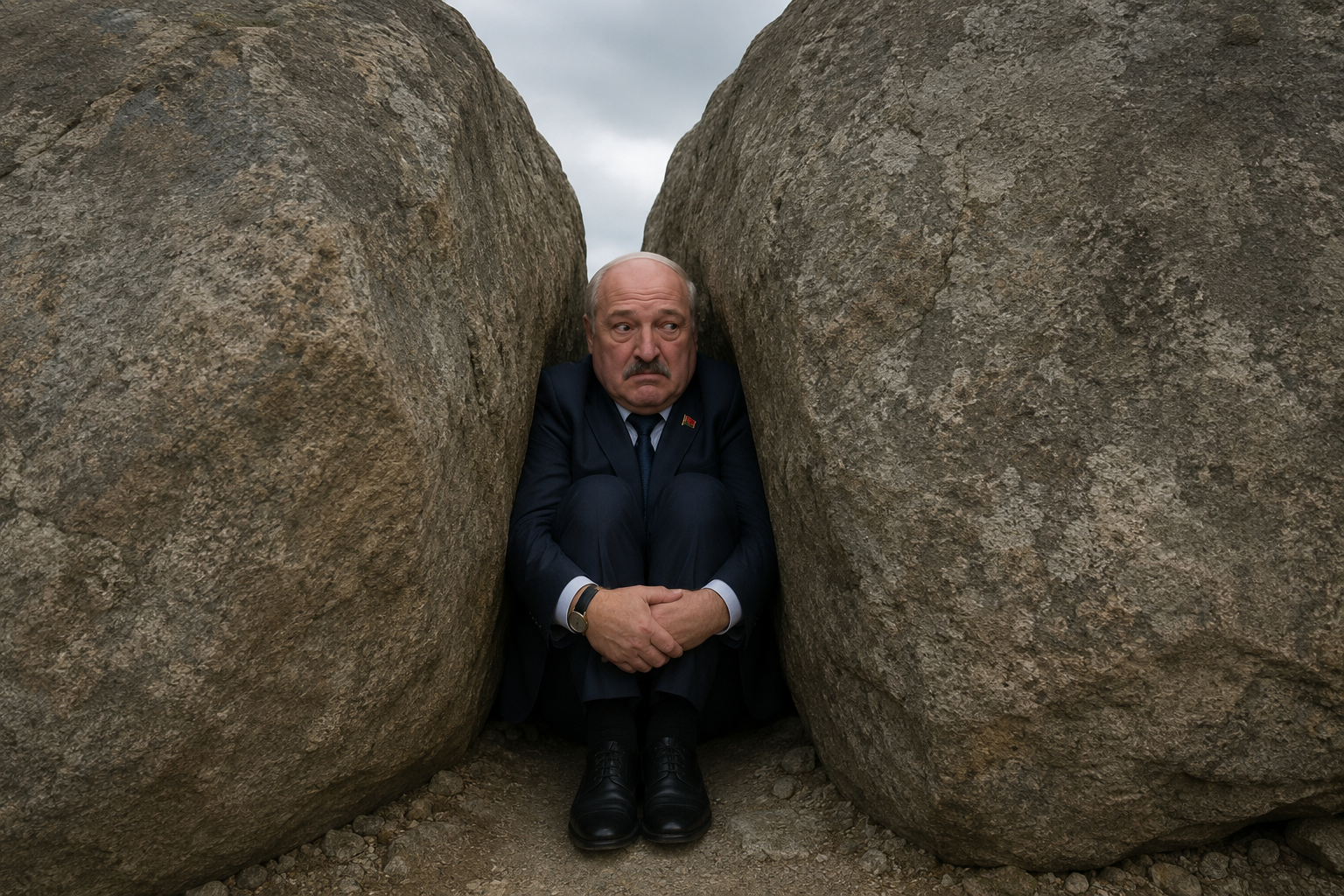
The situation can be understood in light of the fact that, following Zelenskyy’s demand, Lukashenko found himself between a rock and a hard place. On the one hand, he could hardly refuse, as Ukraine now possesses highly precise military capabilities sufficient to disable the relay equipment on Belarusian territory. Lukashenko could not allow such a scenario, as it would have effectively drawn Belarus directly into the war.
Russia, by contrast, appears to have preferred precisely such an outcome. This assessment is supported, among other things, by statements made by Russian propagandists over the past week, claiming that any strike against Belarus would also constitute an attack on Russia and that the Collective Security Treaty Organization (CSTO) would therefore be obliged to become involved.
Lukashenko himself, however, appears determined to avoid being drawn into the war by any means possible.
On the other hand, when Russia launched its full-scale invasion of Ukraine on February 24, 2022—and in the period leading up to it—Belarusian President Alexander Lukashenko gave Vladimir Putin his unequivocal support. Moreover, part of the Russian invasion force entered Ukraine from Belarusian territory. As a result, a situation has emerged in which the two leaders effectively embarked on the venture together, but when the time came to bear the consequences, Lukashenko sought to distance himself. It is worth recalling that, in such circumstances, the Russian president has typically shown little mercy toward former partners.
Following the shutdown of the relay equipment, Lukashenko traveled to Moscow, then to Valdai, and subsequently to Beijing. It appears that this diplomatic itinerary was driven primarily by concerns over his personal security. Those concerns were, in all likelihood, not resolved in Russia, prompting what seems to have been another attempt in China.
The key question now is whether Lukashenko is willing—or able—to pay the price that would persuade Beijing to shield him from Putin’s anger. Whether he will face punishment or be forgiven should become clear before long. One thing, however, has long been evident: Belarus’s aging dictator has outlived his political era. Indeed, he has remained in power well beyond it.