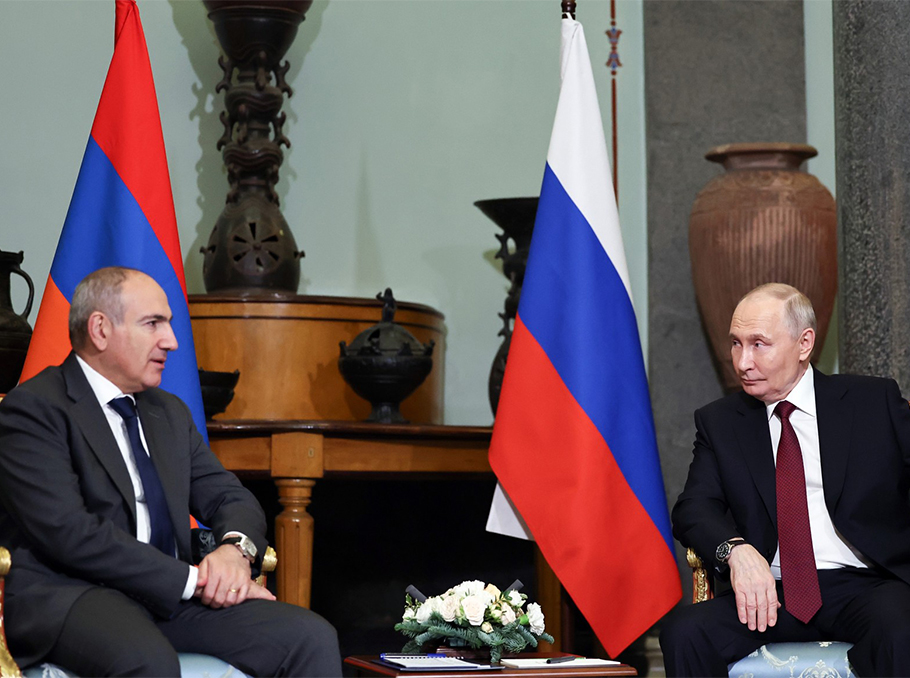

As agreed by Armenia’s prime minister and Russia’s president in Bishkek, the two are expected to meet in Moscow soon to discuss issues of importance to both sides. Yet the very existence of such an agreement suggests that the discussions in Bishkek revealed not only uncertainties but also clear differences between the parties’ positions on certain issues.
These differences presumably concern the two principal issues on which Armenian and Russian officials’ statements diverge: terminating South Caucasus Railway’s contract to manage Armenia’s railway network, and holding a referendum on the choice between the European Union and the Eurasian Economic Union. Several other issues on the agenda that feature in public debate and official statements—a possible change in natural gas prices, Russia’s 102nd military base, the construction of a new nuclear power plant in Armenia, economic problems, and so forth—are essentially secondary to these two central questions. If Armenia’s prime minister travels to Moscow with the clear objective of resolving the railway issue, Putin will do everything possible to push it into the background and steer the dialogue towards other matters.
As for the EU–EAEU dilemma, the pressure will be immense. If Pashinyan managed in Bishkek to link the possibility of holding a referendum to several other issues, this time Russia’s president will be prepared to counter those arguments. Armenia’s prime minister faces a difficult task: finding new arguments that, alongside the previous ones, would demonstrate why holding a referendum at this stage makes no sense. At the same time, Pashinyan must prevent this issue from being linked in any way to the railway question.
The future of the Russian military base in Armenia will likewise depend on whatever agreements the two leaders may reach on the principal issues. The Russian side has already hinted that it could withdraw the base if Armenia raises the question of the terms of its deployment. Armenia, in turn, has effectively indicated that it does not oppose such a prospect. This could mean that, if Russia makes substantial financial demands during the meeting in return for terminating the railway concession agreement, difficult discussions may also follow over the base’s continued operation. In particular, Armenia could cease providing support services for the base or even demand rent. At the same time, even if Russia again proposes withdrawing the base, Pashinyan is unlikely to make concessions, since there is no longer any room to back down.
Whatever happens, Armenia’s prime minister will travel to Moscow with his own agenda but will also have to take part in discussions on unwelcome issues. Reaching agreements that serve Armenia’s interests will be exceptionally difficult this time, but there is no alternative: Armenia is on the verge of reaching its red lines. Whatever the cost, a way must be found to secure the agreements outlined above.