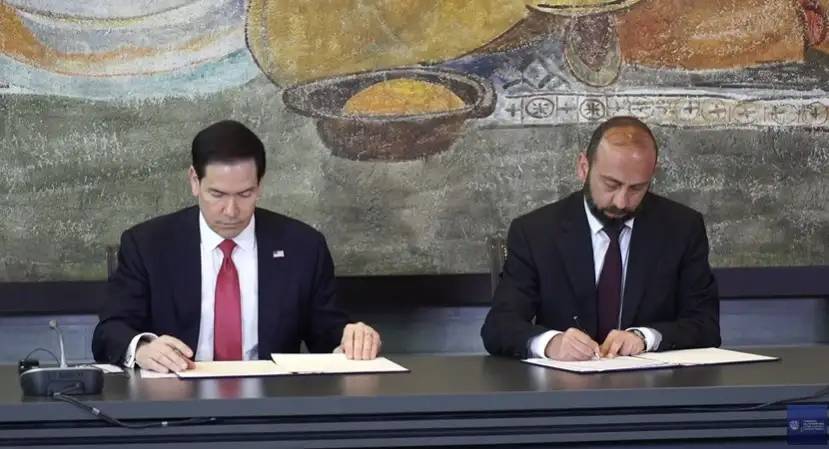

On June 4, Armenian Foreign Minister Ararat Mirzoyan announced the signing of the TRIPP framework agreement with the United States. Prior to that, during U.S. Secretary of State Marco Rubio’s visit to Armenia on May 26, the agreement had been initialed, with officials stating that it would be formally signed once certain technical issues had been resolved. Even at that stage, many analysts considered it plausible that the U.S. administration had chosen to wait until the conclusion of Armenia’s parliamentary elections before proceeding with the final signing.
Yet, just days before the parliamentary elections, the parties signed the agreement. Notably, the U.S. Secretary of State had signed it as early as June 1. This development may have two possible explanations.
The first is that the United States sought to demonstrate support for Prime Minister Pashinyan ahead of the upcoming elections. This interpretation appears unlikely, however, as a highly institutionalized power such as the United States would hardly sign an international agreement solely for the purpose of supporting a particular political force in another country. Moreover, in recent days, confidence in Armenia’s current authorities has already been expressed at the highest levels, providing a sufficiently clear indication of the U.S. position.
The second—and more likely—explanation is that, over the course of recent days, U.S. decision-makers, having analyzed the information available to them, formed a clearer understanding of public sentiment in Armenia. This, in turn, may have strengthened their confidence that the likelihood of an unexpected outcome in the parliamentary elections was exceedingly low. In other words, unlike on May 26, by June 1 the U.S. leadership was already convinced that there would be no change of power in Armenia and that pro-Russian forces would be unable to reverse the TRIPP initiative.
Recent polling and analytical assessments conducted by reputable international organizations point to the same conclusion. The Civil Contract party maintains a substantial lead. While there is skepticism regarding its ability to secure a constitutional majority, its overall victory appears all but assured.
In effect, the United States is expressing confidence at the highest level not in Armenia’s current authorities, but in the Armenian people themselves—demonstrating faith in their determination and ability to make an independent choice. And the people of Armenia will justify that confidence: on June 8, Armenia will celebrate another victory on its path toward strengthening its sovereignty and statehood.