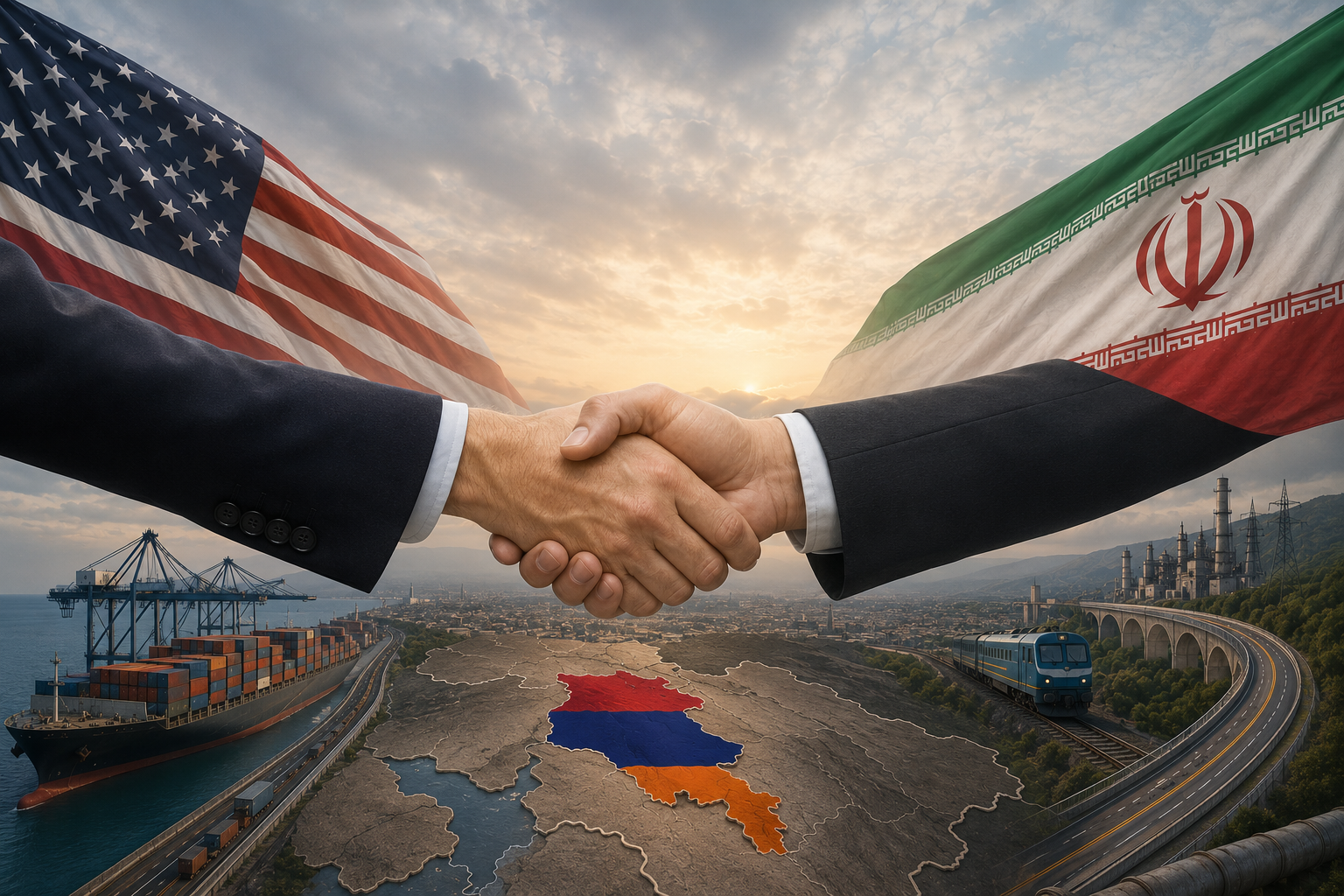

The memorandum signed between the United States and Iran in June 2026—which provides for the partial easing of oil-related sanctions, the release of frozen assets, the restoration of navigation through the Strait of Hormuz, and a 60-day negotiation process aimed at reaching a final agreement—has the potential to reshape not only the geopolitical and economic landscape of the Middle East, but also that of the surrounding regions.
Although the final parameters of the agreement have yet to be defined, it is already evident that the potential expansion of Iran’s integration into the international economy could have significant implications for the South Caucasus, particularly with regard to Armenia’s economic, transportation, energy, and foreign policy environment. For Armenia, Iran is not merely a neighboring state; it is also a vital transit route, an energy partner, and an important contributor to maintaining the region’s strategic balance.
New Opportunities for Economic Cooperation
For decades, international sanctions have significantly constrained Iran’s economic potential, foreign trade, and integration into the global financial system. The partial easing of oil-related sanctions, the release of frozen assets, and the prospect of an improved investment climate could increase Iran’s foreign currency revenues and stimulate broader economic activity.
Against this backdrop, Armenia stands to benefit primarily through expanded opportunities for bilateral economic cooperation. In recent years, even under the constraints of international sanctions, Armenia–Iran trade has demonstrated steady growth, increasing from approximately USD 400 million to USD 768 million. The leadership of both countries has declared a shared objective of raising bilateral trade to USD 1 billion, and if some of the existing financial and banking restrictions are eased, achieving that target could become considerably more realistic.
The facilitation of financial transactions would also ease the operating environment for Armenian businesses by reducing obstacles related to payments, imports, and exports. Sectors with particularly strong growth potential include agriculture, the food processing industry, pharmaceuticals, construction materials manufacturing, and light industry.
At the same time, Iran’s market of nearly 90 million people could become a more attractive destination for Armenian exports, provided that the relaxation of international financial restrictions improves market accessibility.
The Strategic Importance of Transport Connectivity
Another key component of the memorandum is the restoration of international navigation through the Strait of Hormuz, a development that could contribute to increased logistical activity across the Persian Gulf region.
This shift adds further strategic significance to the infrastructure projects already under discussion between Armenia and Iran, including the North–South Highway, the Persian Gulf–Black Sea transport corridor, the modernization of border infrastructure, and the expansion of transit transportation.
Should Iran gradually reintegrate into international trade networks, it could emerge as a key transit hub linking Europe with India and China. In such a scenario, Armenia would have an opportunity to strengthen its role as a regional transport corridor and as a center for logistics services, warehousing, and cargo distribution.
The easing of tensions in U.S.–Iran relations also creates a more favorable environment for the implementation of the Trump Route for International Peace and Prosperity (TRIPP) initiative. On June 4, Armenia and the United States signed the agreement on TRIPP. The agreement is still subject to the necessary ratification procedures, while construction is expected to begin during the second half of this year, making regional stability more critical than ever to the project’s successful implementation.
The implementation of the TRIPP initiative, together with the gradual unblocking of regional transport links, could also create additional opportunities for Iran. By restoring its railway connection with Armenia through Julfa and expanding access to Black Sea ports, Tehran could likewise become integrated into this emerging transit network. This, in turn, could substantially enhance the project’s regional economic appeal while helping to mitigate potential Iranian opposition.
Prospects for Expanding Energy Cooperation
Energy remains one of the principal pillars of Armenia–Iran cooperation. At present, the two countries operate under a “gas-for-electricity” exchange arrangement, although its scale has been significantly constrained by international sanctions.
Should the restrictions imposed on Iran be eased, Armenia could gain greater opportunities to import Iranian natural gas, thereby contributing to the diversification of its energy supply. Over the longer term, increasing the capacity of the existing gas pipeline—which would require technical modernization—or developing new energy infrastructure could also become viable options for discussion. The implementation of such projects, however, will depend not only on economic considerations but also on the prevailing political environment.
Another important component of deepening bilateral energy cooperation is the third 400 kV Iran–Armenia power transmission line, which is scheduled for completion by 2027. Once operational, it will substantially increase electricity exchange between the two countries, enable more efficient synchronization of their power systems, and strengthen the transit potential of the North–South Energy Corridor.
Foreign Policy and Security Implications
The potential normalization of U.S.–Iran relations could also alter the regional balance of power. If the easing of economic pressure enables Tehran to allocate greater resources to its foreign policy, Iran may increase both its economic and political engagement in the South Caucasus.
For Armenia, this carries important security implications as well. Iran has consistently reaffirmed its support for Armenia’s territorial integrity and its opposition to any attempt to alter regional borders through the use of force.
At the same time, the expansion of Iran’s integration into the international economy could provide Armenia with additional opportunities to diversify both its foreign policy and economic partnerships, without requiring it to abandon its existing strategic relationships.
Limitations and Uncertainties
Nevertheless, the potential impact of the process should not be overstated.
First, the United States and Iran have so far signed only a memorandum, and the conclusion of a final agreement will depend on the outcome of the forthcoming negotiations.
Second, the arrangements currently under discussion do not envisage the complete removal of all sanctions imposed on Iran. Rather, they primarily concern the partial easing of restrictions on the oil sector and certain financial measures, while numerous secondary sanctions are likely to remain in place.
Third, the security environment in the Middle East remains highly volatile. Any renewed regional crisis or the failure of the negotiations could significantly constrain the realization of the anticipated economic benefits.
Conclusion
The potential normalization of U.S.–Iran relations offers Armenia not so much immediate gains as a new window of opportunity. The expansion of economic cooperation, the development of transport corridors, deeper energy interconnectivity, and the strengthening of Armenia’s role in regional logistics are among the principal areas in which the country could benefit from Iran’s growing integration into the international economy.
At the same time, the realization of these opportunities will depend on several interrelated factors: the substance of a final U.S.–Iran agreement, the actual scope of sanctions relief, the regional security environment, and—no less importantly—Armenia’s own policy choices. If Yerevan succeeds in accelerating the implementation of infrastructure projects, improving the investment climate, and pursuing proactive economic diplomacy, the evolving geopolitical landscape could be transformed into long-term economic and strategic advantages for the country.
Narek Minasyan
This article was produced by the Armenian Council Research Center with the support of the Yerevan Office of the Friedrich Naumann Foundation for Freedom in the South Caucasus.
The views and opinions expressed in this article do not necessarily reflect those of the Friedrich Naumann Foundation for Freedom or its staff.