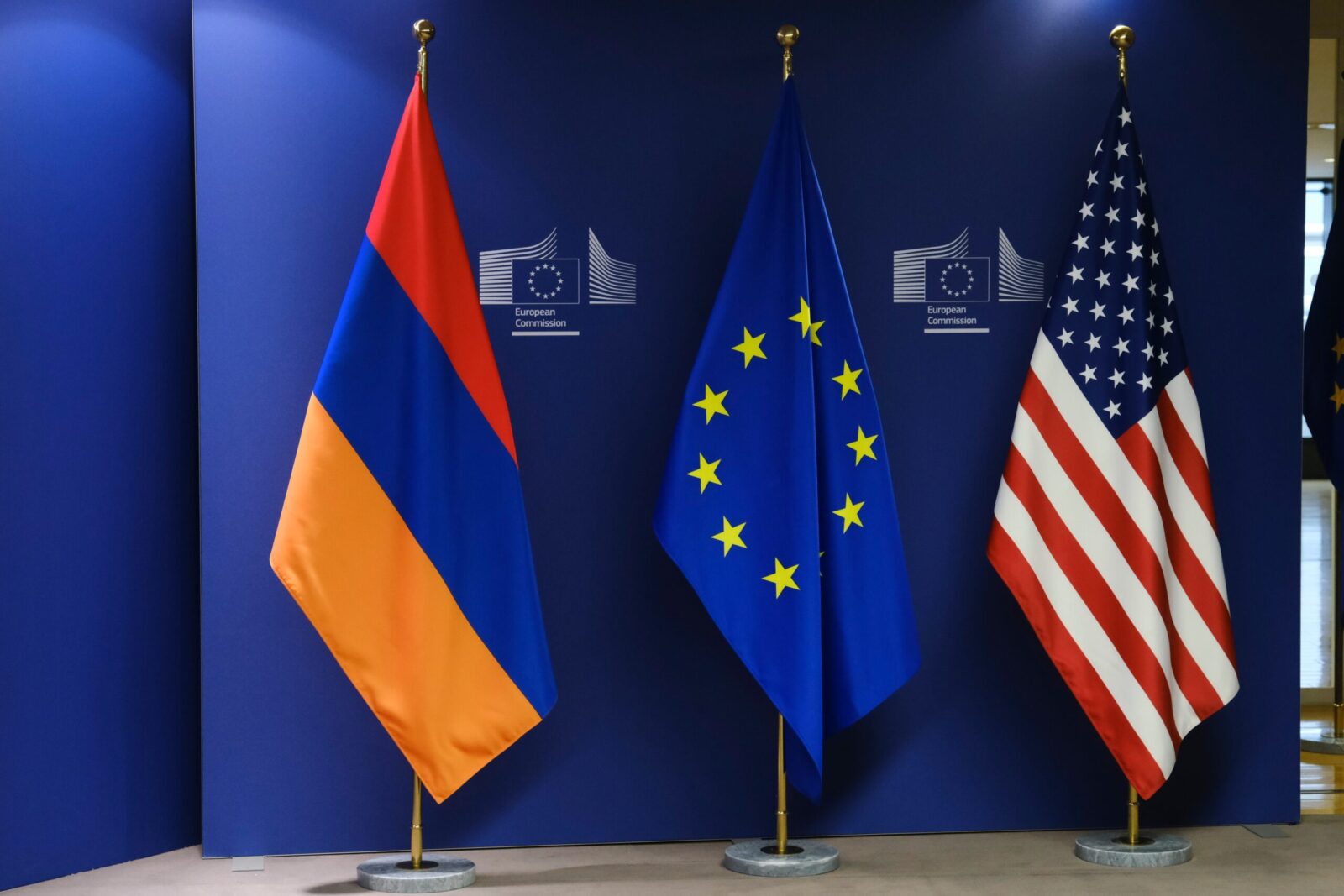

In recent years, Armenia’s democratic development has entered a stage in which it can no longer be viewed as a purely domestic process. It is unfolding amid profound geopolitical shifts, changes in the regional security architecture, and intensifying competition among major powers. In this context, democracy in Armenia has taken on a layered character, serving simultaneously as a model of domestic governance, a source of foreign policy legitimacy, and, in certain circumstances, a point of vulnerability.
Recent international experience shows that democratic development in small and medium-sized states almost always unfolds under conditions of external security pressure. In the Baltic states—Estonia, Latvia, and Lithuania, for example—the strengthening of democratic institutions took place alongside integration into NATO and amid enduring concerns over Russian security threats.
Armenia is no exception to this pattern. The security environment that emerged after 2020 fundamentally reshaped the state’s priorities. Whereas democratic reforms had previously been viewed primarily as a long-term path toward institutional development, the challenges that emerged after the war forced the state to adopt rapid, and often unconventional, crisis-response measures. State resilience, border security, military reform, and the search for new foreign policy partners became central items on the national agenda.
At the same time, it was precisely within this complex environment that democracy became more clearly understood not only as a normative choice, but also as a factor of state resilience and viability. The strengthening of democratic institutions and greater transparency in governance enhance a state’s international credibility and create broader opportunities for cooperation. In Armenia’s case, it was specifically the country’s commitment to the democratic agenda that made possible the deployment of the European Union Mission in Armenia (EUMA), assistance through the European Peace Facility, the deployment of the European Union Partnership Mission (EUPM), and the launch of Armenia–EU security and defense consultations. In this context, democracy has become an important diplomatic asset, opening new avenues for cooperation.
At the same time, this process also faces structural limitations. External support for democracy is not always accompanied by clear and institutionalized security guarantees. This reality often becomes the subject of domestic political manipulation, giving rise to the false dilemma of “democracy versus security.” Certain political circles in Armenia argue that centralized or authoritarian models are better equipped to respond effectively to security challenges.
This approach, however, overlooks international experience: most of the world’s leading economic, technological, and military powers are democratic systems. Moreover, long-term security tends to be more sustainable in systems where accountability, institutional oversight, and
checks and balances are firmly established. In this sense, democracy is not an alternative to security, but one of its structural foundations.
Armenia is currently in a period of democratic transition. In international democracy indices, it is often classified as a hybrid or transitional system, where institutional stability is still in the process of consolidation. As Samuel Huntington once noted, the stability of political order depends not only on the degree of democracy, but also on the level of institutional development.
Elections as a Democratic “Stress Test.” The upcoming parliamentary elections can be viewed as an institutional “stress test” for Armenia’s democratic system. They will test not only the technical quality of the electoral mechanisms, but also the resilience of the political system under conditions of both external and internal pressure.
These elections are particularly notable for their high degree of geopolitical in nature. Since Armenia’s independence, there have rarely been situations in which domestic political competition has been so closely intertwined with the interests of regional and global power centers. Within the framework of the pre-election campaign, the foreign policy orientations and approaches of political forces are already becoming clearly visible, while various power centers are not concealing their interest in political developments in Armenia. As a result, the electoral process is turning not only into a matter of domestic political choice, but also into an arena of informational, diplomatic, and ideological competition and influence, often manifested through hybrid instruments and methods.
At the same time, it is important to understand that elections in themselves do not resolve strategic security or development challenges. Rather, they serve primarily as a mechanism for the reproduction of political legitimacy, rather than a final solution to systemic problems. For this reason, post-election political stability becomes just as important as the conduct of the elections themselves.
The Main Obstacles to Armenia’s Democratic Trajectory. One of the principal obstacles to Armenia’s democratic development continues to be the weakness of its institutions. Although a number of reforms have been implemented in recent years, the stability and predictability of state institutions still remain insufficient. This limits the long-term effectiveness of political decision-making and creates dependence on short-term or situational solutions.
A second major challenge is the deepening of political polarization. In Armenia, political discourse often moves beyond the framework of ideological competition and turns into a value-based and highly personalized confrontation, reducing the possibility of compromise and hindering the inclusiveness of the political system.
A third issue is the continued vulnerability of the information environment. Disinformation flows, external informational influence, and rapidly spreading narratives on social media can significantly undermine public trust in state institutions. This is particularly dangerous for transitional democracies such as Armenia, where institutional resilience remains limited.
Taken together, these factors create a situation in which democratic development requires not only political will, but also a long-term institutional strategy and broad social cohesion.
Conclusion. Despite the existing challenges, Armenia’s democratic system continues to demonstrate a certain degree of resilience. The active role of civil society, the presence of public political debate, and a competitive political environment indicate that democracy continues to retain its vitality.
Nevertheless, its further development will depend on institutional strengthening, the evolution of political culture, and a balanced foreign policy approach.
Thus, Armenia’s democratic trajectory is shaped not through linear development, but through a complex interaction of factors in which domestic institutional dynamics and external geopolitical pressures continuously influence one another.
— Narek Minasyan