
Author: Milo Gwynne
Armenian National Assembly Elections 07/06 – Observational Report.
N.B. The following document is the opinion and observations of an individual observer and in no way claims to reflect the full report of Independent Observer.
Election Day Summary
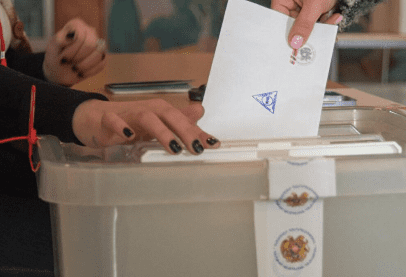
On June 7th 2026, I worked as an international observer for an Armenian organisation called Independent Observer. I worked in a small group with another international observer and a local observer who also served as a translator. Together, we observed several polling stations in the Kanaker-Zeytun region.
Typically, we observed that the electoral process at our polling stations was carried out properly and with few issues. We did not encounter any extraordinary events such as power outages, arguments or fights near or inside the polling stations, or bribery. Procedures before the start of voting at 08.00, as well as during the count, were followed correctly. Voting started on time and concluded at exactly 20.00, with no one outside the polling station at the end of voting allowed to cast a vote. Nonetheless, our group recorded a number of violations that were sometimes not corrected.
The most common violation we recorded related to the conduct of proxies within the polling station. We recorded a violation committed by proxies at 80% of the stations we observed. Most commonly, proxies that violated regulations came from either ‘Strong Armenia’ (3) or ‘Armenia Alliance’ (17). These proxies frequently violated the electoral code by bringing more proxies into the polling station than they were permitted to. 2 proxies from each party inside at the same time is the maximum, and we sometimes observed 3 or 4 proxies from the same party in the same polling station. Moreover, proxies were frequently able to enter and exit polling stations without registering with the polling station’s commissioner, which represents a violation. It is fair to say that commissioners often took a passive approach toward party proxies, allowing them to act however they pleased, even if their conduct could have been in breach of the electoral code. For example, proxies from ‘Strong Armenia’ and ‘Armenia Alliance’ on more than one occasion engaged in lengthy conversations with queuing voters, and these protracted interactions could easily have been used to campaign, apply pressure, or otherwise influence voters. At one polling station, the proxy from the ‘Civil Contract’ (16) Party was allowed to assist staff by entering the voting booths (while there were no voters inside) and helping to clear unused ballots. This represented a clear and significant violation, but when the polling station commissioner refused to prevent it, assuring observers that it was appropriate because clearing the ballots was a man’s job (the proxy was a man, and the polling station was staffed only by women). This statement exemplifies the typical attitude we found among staff towards proxies – overtly carefree and lacking sufficient monitoring of their behaviour.
We also observed one instance of campaign material having been placed too close to a polling station. At one station, the bus stop immediately outside the polling station had a large poster for ‘Armenia Alliance’ within the advertising frame. The poster was at most 15 metres away from the polling station, which represented a clear violation of the electoral code. However, when we passed the issue to the police and polling station staff, they were unable to cover the poster or take any meaningful action, and it remained up all day.
We observed that voters of all ages largely understood the electoral process. We observed only one instance of a voter attempting to vote at the incorrect polling station. All the technical equipment, fingerprinting devices, and printers we observed functioned without issues. Only once did we observe a voter misunderstanding the voting booth and accidentally voting on the wrong side (eliminating the secrecy of their vote). On several occasions, however, voters requested a pen or pencil, not understanding that their ballots should be cast without marking. During the count that we watched, of 1,120 votes cast, we counted only three with more than one ballot in the envelope. It can therefore be concluded that nearly all voters had a strong understanding of the voting process.
The conditions of polling stations were mixed. Every polling station met the basic requirements – such as the secrecy of the voting area – but many had significant issues with space and accessibility. For example, one polling station advertised as ‘fully accessible’ had cars parked in front of the ramps, preventing wheelchair users from accessing it. Another polling station that had a wheelchair ramp had it at such a steep angle that it would not have been possible or safe for a wheelchair user to use independently. Older voters and voters using walkers almost always had to rely on family or other voters to reach the polling stations. Furthermore, the space inside most polling stations was very limited. When Samvel Karapetyan arrived to vote at polling station 3/27, the polling station had to be shut to voters for nearly 30 minutes so he could enter and exit without incident. Afterwards, the number of journalists that remained inside the polling station took up most of the space, limiting space for observers, proxies and voters. Most polling stations in Kanaker-Zeytun had to make voters queue outside due to a lack of space in the buildings, particularly during the busiest period from 12.00 – 16.00. The outdoor queuing, combined with temperatures of 29 °C, posed problems for voters, especially the elderly. Nonetheless, queues moved quickly, and voters rarely waited more than 15 minutes outside.
Despite these issues, the voting process that we observed was acceptable. There was a low level of tension between proxies of different parties, who typically remained cordial with one another. As far as we could see, there was no evidence of voter transportation by a political organisation, provocations by proxies, or voter control. The rights of media and observers were nearly always respected, and observers were admitted only with the required documentation. There was no attempt to prevent or discourage observer groups or the media at any of the stations we visited. Police sometimes checked the credentials of observers when they witnessed filming inside or outside the station, but were respectful of observers’ right to film once documentation was provided. The maximum number of observers per organisation was not breached, and staff were clear in showing observers that they were following protocol in the time before the vote started and during the counting process.
The counting process that we observed was transparent and clear. There was one issue: the number of face cards left by voters (1,119) did not match the total number of votes (1,120). It was concluded that one voter must have accidentally taken their face card with them after voting, indicating a slightly weak understanding of that part of the voting process. During the count, protocols were consistently and correctly followed. One ballot without a stamp was not counted, as were a few envelopes with two ballots, and several envelopes with ballots ripped in half. Once the commission had decided to accept one creased (but not ripped) ballot, they maintained that rule for future ballots. There were no other notable moments during the count, and proxies from ‘Strong Armenia’ and ‘Civil Contract’, as well as the entire CEC team, agreed with the final tallies.
Conclusions on the process and recommendations
While the voting process we observed was largely adequate, it included a few particularly good practices and some notable issues. Firstly, the transparency of the voting process and the safeguards against ballot stuffing, double voting and election rigging were extremely strong. The decision to livestream nearly every polling station was a good practice that maintained transparency throughout the voting and counting process. This also provides international observers, citizens, and the CEC with a clear account of exactly what occurred at a polling station throughout the day. Secondly, the way voters and ballots were processed made it extremely difficult to cheat during the voting process. Staff were vigilant to ensure that no two people entered the same voting booth, even for a short time. The electronic machines worked to ensure that voters did not cast ballots at the wrong station or more than once. The system of printing facial receipts for voters ensured that each ballot in the box was attributable to a voter, without breaching secrecy. The stamping of each verified ballot prevented anyone from stuffing ballots into the box without first validating them. Ultimately, the safeguards against cheating and wrongdoing at voting stations in Armenia are equal to or better than those in the United Kingdom, where I am also familiar with the voting process. One recommendation might be to ask voters to use a pen or a pencil to mark their vote, if only to provide another layer of security that each ballot was cast by a voter and was not fraudulent. Moreover, the process could easily be streamlined and sped up. Staff had to pass each voting member eighteen separate ballots, allowing the voter to choose one, and leave the rest in the voting booth. While staff were well-trained and worked quickly, this still cost time and contributed to queues. In the future, the system could use a single larger ballot with all options available for the voter to mark, which would save both time and resources.
Despite these positives, there were still some issues that could be rectified before Armenia’s next election. There should be serious questions asked about the role of proxies. In some nations, citizens can be registered as proxies without a party affiliation and perform the functions that party proxies provide in Armenia. If limits on party proxies are not respected, it would be better to insist that they remain in a particular area in the polling station, preferably away from voters and voting booths. Alternatively, party proxies could be removed altogether if non-partisan civilian observation missions are sufficient to monitor polling stations. It should be noted, however, that proxies generally expressed that their presence reassured voters who were sceptical about the transparency of the elections, and it is possible to see that removing them as a function might be perceived as undemocratic. The condition of polling stations themselves was sometimes barely adequate, and it would benefit the voting process to identify larger buildings that could be utilised next time. Some polling stations contained material that might be construed as supporting a particular party’s rhetoric. For example, three polling stations had posters, information or monuments to the military. It might be argued that this could constitute material supporting the views of certain parties that were more militaristic. While covering or temporarily removing these materials would certainly be unpopular, it might be the fairest way to proceed in the future.