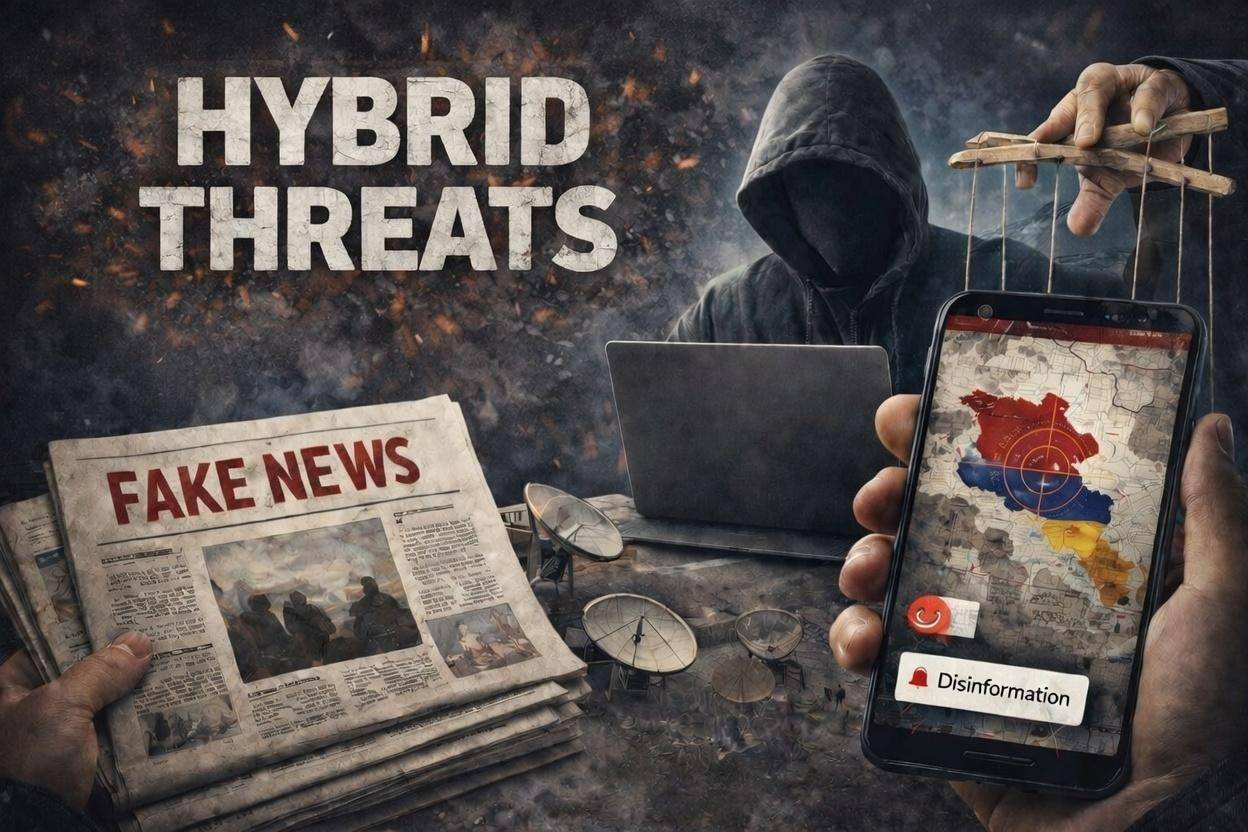

Hybrid Threats in Armenia: Information Attacks
In recent months, processes have become noticeably more active within Armenia’s information and political space that, upon analysis, may be characterized as hybrid threats. The definitions and essence of hybrid threats were examined in the first part of this article. Briefly summarized, hybrid threats include disinformation, attempts to influence domestic political processes, cyberattacks, the use of political networks, threats involving economic leverage, and similar tools.
The issue of hybrid threats directed against the Republic of Armenia occupies a significant place in today’s public and political discourse. A considerable number of commentators, including representatives of the authorities, argue that these threats originate from a specific center—Russia. The Kremlin, however, categorically denies the existence of such threats. During a meeting in Moscow with Speaker of the National Assembly of Armenia Alen Simonyan, Russian Foreign Minister Sergey Lavrov stated:
“It is strange to hear the regularly repeated statements about mythical attacks allegedly being prepared against Armenia from the north. In essence, your parliamentary election campaign has already begun. And I can assure you that when signals come from abroad—clearly hinting at Russia—that someone is preparing to interfere [in the elections], and when calls are made from Yerevan to the European Union to prevent such interference, all of this appears strange to us. I believe responsible political figures in Yerevan understand that such steps are taken with clearly provocative intentions.”
Below are the main components of these actions, accompanied by specific examples that demonstrate what may be described as a Russian trace behind these threats.
Information Manipulation and Disinformation Campaigns: False “Investigations” and “Statistics”
In November 2025, an organization called the “Foundation to Battle Injustice” published an article claiming that, by direct order of Prime Minister Nikol Pashinyan, his political opponents were being subjected to torture in Armenian prisons. In the article, Pashinyan was depicted in a Gestapo uniform against imagery resembling a concentration camp. It was further claimed that the number of detainees in Armenia allegedly exceeds 24,000 and that between 2020 and 2025, at least 230 opposition figures had died in prisons as a result of torture or suicide.
Naturally, no substantiation was provided for these claims; it was merely stated that the information had been supplied by sources close to the government. It should also be noted that this so-called “investigation” is interwoven with certain real issues in order to create the illusion of a serious and weighty inquiry.
It is a well-known fact that the aforementioned “foundation” was established by the late Yevgeny Prigozhin, head of the Russian Wagner group, and has disseminated anti-Western narratives and Russian propaganda content. The organization has previously circulated other false materials related to Armenia, including allegations about Western pharmaceutical experiments in the country and claims regarding a supposed “child abuse network” involving the Speaker of the National Assembly.
Use of “Western” Journalists to Appear Credible and Objective
In the article concerning Armenia’s penitentiary institutions, Irish journalist Chay Bowes and German journalist Thomas Röper were presented as Western sources. However, both have worked with Russian state media and have repeatedly been accused of spreading disinformation. Röper has even been subject to EU sanctions for disseminating disinformation related to the Russia–Ukraine war.
Disinformation about Armenia and theses aligned with Kremlin narratives have also been disseminated by other non-Russian “experts” who maintain various forms of connection to the Kremlin.
This method—attempting to legitimize one’s own narrative through ostensibly external and “independent” voices—is characteristic of Russian information operations.
It should be emphasized that such publications—originating from pro-Russian websites, pro-Russian experts, or directly from Russian media outlets and affiliated commentators—are numerous. Moreover, the above-mentioned material, along with other similar pieces, has been actively circulated by several Armenian media outlets and social media users promoting anti-Western, anti-government, and pro-Russian agendas. Armenian fact-checking organizations have addressed these publications in detail.
Threats and Accusations by Kremlin Propagandists, Including Statements on the Need for Military Action Against Armenia
Below are excerpts from various statements by Margarita Simonyan, Editor-in-Chief of the Russian state media holding Russia Today (RT), concerning Armenia:
“Any Armenian who dares to criticize Russia should go and cut out his dirty tongue.”
“Essentially, after what you have done, Russia has the full moral right to spit on you and crush you. But it will not act that way. I am sure of it. This time as well, it will help. Russia is like that—generous and noble, my beloved homeland.”
“Apart from Russia, no one has ever helped Armenia and no one ever will. Not knowing this means not wanting to know. Not wanting to know is voluntary stupidity. And voluntary stupidity is usually punished harshly by history.”
“I hope Armenians will not follow the example of Ukrainians, who are destroying monuments to Catherine II, the founder of Odesa…”
In these examples, the Kremlin propagandist employs a language of threats and insults toward Armenia (“I hope Armenians will not follow the example of Ukrainians,” “harshly punished by history,” “voluntary stupidity,” “dirty tongue,” “spit on you and crush you,” etc.).
Incidentally, publications containing implicit threats suggesting that Armenia could face the fate of Ukraine have periodically appeared in leading Russian media outlets, for example: “…we hope Yerevan will not choose the path of the Kyiv regime in its relations with Moscow…”
Recently, however, such rhetoric has become more direct and severe, particularly in statements by well-known propagandist Vladimir Solovyov, who effectively expressed the view that it would be appropriate to launch a “special military operation” against several countries, including Armenia.
In the third and final part of this article, I will continue to present and analyze examples of information attacks bearing a Russian trace and will also address cyberattacks and economic threats.
Edgar Vardanyan
Associated Expert, Armenian Council