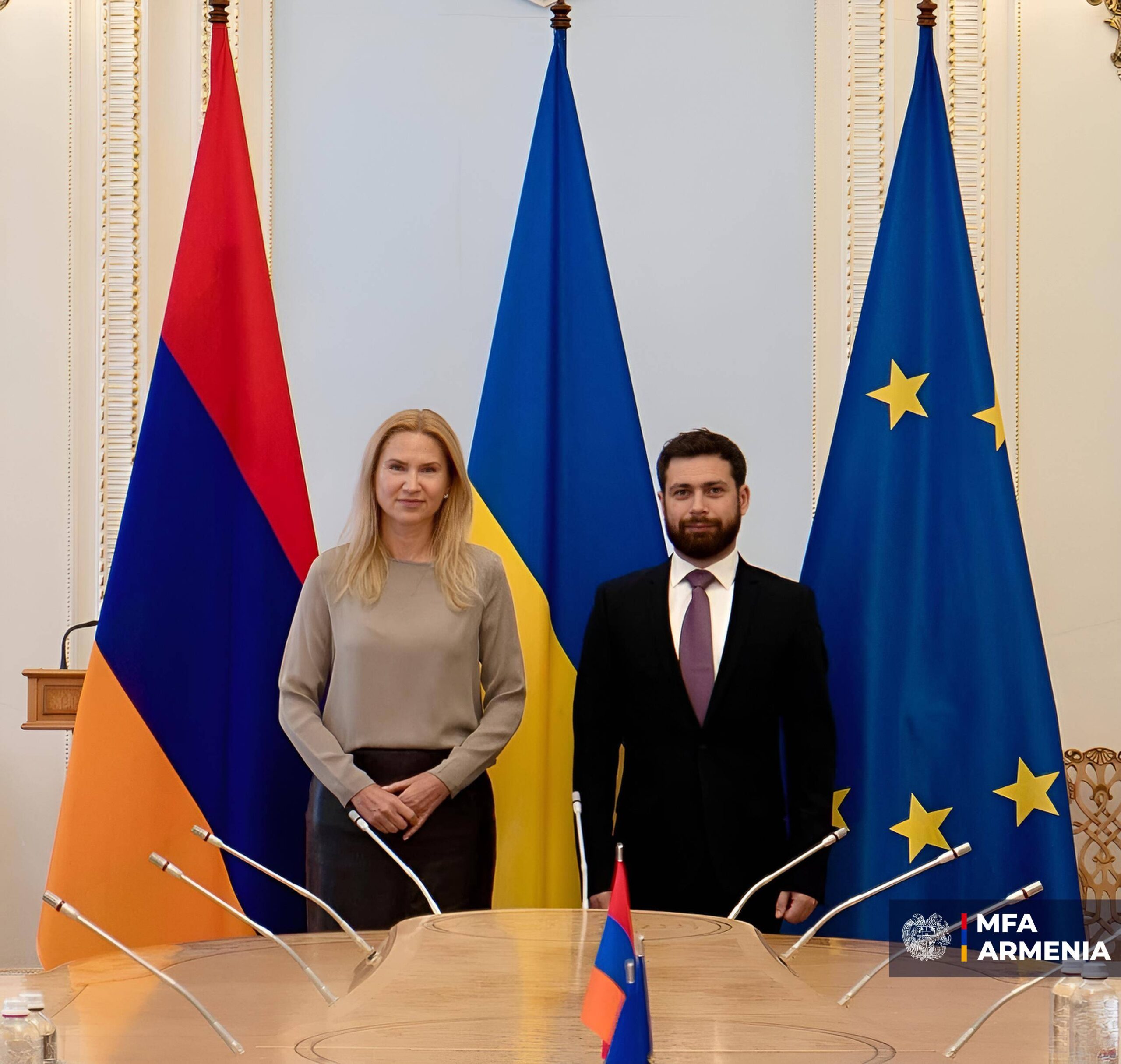

In recent months, there has been a notable increase in activity in interstate contacts between Armenia and Ukraine. The first noteworthy development was Ukrainian President Volodymyr Zelenskyy’s participation in the European Political Community Summit held in Yerevan in early May 2026, during which he held a separate meeting with Armenian Prime Minister Nikol Pashinyan [1]. Following Armenia’s parliamentary elections, bilateral relations have continued to develop with unprecedented momentum: Pashinyan and Zelenskyy have already held a phone call [2], while parliamentary speakers Ruben Rubinyan and Ruslan Stefanchuk [3], as well as Foreign Ministers Ararat Mirzoyan and Andrii Sybiha [4], have also been in contact. This was followed by a visit to Kyiv by Deputy Foreign Minister Vahan Kostanyan, who held meetings with Ukrainian Deputy Foreign Minister Oleksandr Myshchenko [5] and Deputy Speaker of the Verkhovna Rada Olena Kondratiuk [6]. This unprecedented intensification points to a qualitatively new phase in relations between Yerevan and Kyiv, driven by both geopolitical and regional shifts and a mutual willingness to navigate around the existing “red lines.”
Intensification of Political Dialogue
An opportunity to revitalize political dialogue between Armenia and Ukraine emerged as early as 2018, following Armenia’s “Velvet Revolution,” and in 2019, following Volodymyr Zelenskyy and his Servant of the People party coming to power in Ukraine. Key factors conducive to closer political relations included similarities in the countries’ domestic agendas, including pledges of democratic reforms; the international community’s positive attitude toward both countries and the potential for external support; and, of course, the presence of a sizeable and influential Armenian community in Ukraine, setting aside historical ties and the enormous untapped potential in bilateral relations. In addition, the passivity of bilateral relations in previous years had contributed to Ukraine’s unequivocally mutually beneficial cooperation with Azerbaijan and Türkiye, as well as to a hardening of Kyiv’s position on the Nagorno-Karabakh conflict. Differences in foreign policy orientations and the nature of the two countries’ relations with Russia further complicated the dialogue between Yerevan and Kyiv.
However, that “window of opportunity” closed first with the spread of the COVID-19 pandemic and subsequently with the 2020 44-day war and the outbreak of the Russian-Ukrainian war in 2022. From Kyiv’s perspective, Armenia’s neutrality or cautious position was viewed as indirect support for Moscow’s policies, while in Yerevan, Ukraine’s rapprochement with and statements in support of Baku were met with concern.
The “breakthrough” in the dialogue in recent years came as a result of new geopolitical and regional realities. Russia’s and the CSTO’s inadequate response to Armenia’s security challenges pushed Yerevan toward diversifying its foreign policy and deepening relations with the West, including its pursuit of EU membership. This was one of the first signals for Kyiv. The first practical steps that “broke the ice” were the visit of the Armenian Prime Minister’s wife to Kyiv in September 2023 [7] and Armenia’s dispatch of humanitarian assistance to Ukraine on several occasions [8], followed by contacts between Armenian and Ukrainian officials on various occasions and at different events on Western platforms. Therefore, it is possible to identify the clear intensification of relations as beginning in the second half of 2023. These steps demonstrated that Yerevan was prepared to cross certain “red lines” that had existed for decades due to its allied obligations toward Moscow.
Reassessing the Relationship
For Yerevan, reassessing its relations with Kyiv has clear strategic significance. First and foremost, it represents another manifestation of the strengthening of relations with the West. Both countries have expressed their intention to join the EU, and greater engagement and exchange of experience between them could have a positive impact on their European aspirations and, more broadly, on the deepening of their relations with the West. Engagement with Ukraine could enable Yerevan to integrate more smoothly into the European security and political architecture. Second, the establishment of peace in the South Caucasus is gradually weakening the logic of a “zero-sum game,” and direct dialogue with Ukraine would allow Yerevan to gradually restore a more balanced position in Kyiv’s relations with Armenia and Azerbaijan. Third, within the framework of Armenia’s diversification policy, an underestimated but highly important area is the expansion of dialogue and economic relations with Eastern European countries. In this regard, Ukraine could also become an important partner.
As for Kyiv, it has been gradually deepening relations with a number of post-Soviet countries that have traditionally maintained allied relations with Moscow. Recently, Volodymyr Zelenskyy also made an unambiguous statement about a policy of intensifying ties with Armenia, Azerbaijan, and Moldova [9]. This has important strategic significance for Kyiv. At the same time, Ukraine also needs to balance its relations with the countries of the South Caucasus. The tensions and political differences observed in its relations with Georgia are prompting Kyiv to reconsider its traditional approach toward Armenia, as evidenced by the more balanced statements coming from Ukraine in the context of Armenian-Azerbaijani relations in recent months. This will allow Ukraine to maintain its diplomatic presence in the South Caucasus and potentially become involved in regional processes in the future. Promoting European and Eastern European agendas is also a priority for Kyiv, and in this regard, Armenia can be viewed as a “natural partner.”
It is clear that it is important for Armenia to maintain its position on Ukraine while at the same time ensuring that these relations do not turn into a policy directed against Russia. In an interview with CNN Prima News in 2023, Armenian Prime Minister Nikol Pashinyan stated: “We are not Russia’s ally in the war with Ukraine” [10]. This position has been reiterated unequivocally on other occasions since then.
At the same time, Moscow often views Armenia’s diversification policy as “anti-Russian.” Any rapprochement between Yerevan and Kyiv is perceived in Moscow as highly sensitive, unlike, for example, Azerbaijan-Ukraine relations, given that Russia and Azerbaijan signed the Declaration on Allied Interaction just days before the outbreak of the war in Ukraine. Another obstacle in Armenia-Ukraine relations is Ukraine’s deep economic ties with Azerbaijan, including the active presence of the Azerbaijani state oil company (SOCAR) in Ukraine and energy cooperation. Taking these challenges together, it should be emphasized that Yerevan’s caution stems both from the possibility of a Russian reaction and from the deep-rooted nature of Ukraine-Azerbaijan relations. It is therefore important to analyze and assess the extent to which Kyiv is prepared to realistically balance its partnerships with the countries of the South Caucasus.
Expectations and Prospects
For the intensification of Armenia-Ukraine ties to move beyond the level of political statements and diplomatic contacts, it needs to be underpinned by strong economic and humanitarian components.
First, the trade component needs to be strengthened. If we examine export and import volumes since 2020, a significant decline can be observed [11]. According to official data, bilateral trade turnover amounted to
approximately $108.5 million in 2025, compared with around $169 million in 2021 [12]. Amid the trade restrictions that Russia has recently imposed on Armenia, Ukraine could be considered as one of the alternative destinations for Armenian exports. In addition, Ukraine could also be an important country for diversifying imports of strategically significant goods, such as grain. It is estimated that Ukraine harvested around 77 million tonnes of grain in 2024, making it one of the leading grain exporters. Ukraine is also a leading exporter of vegetable oil and could therefore play an important role in strengthening Armenia’s food security.
Another key, albeit long-term, area is logistics. Despite the war, Ukraine continues to seek alternative routes for trade and transit to the Middle East and Asia. In the South Caucasus, the process of unblocking transport and communication routes is also moving forward, albeit with certain challenges, while Armenia itself is pursuing a path of diversification. Therefore, through Black Sea ports and railway and road routes passing through Georgia, Armenia could become a transit hub to Iran, India, the Middle East, and Asia. However, realizing this vision requires peace between Ukraine and Russia, as well as the opening of Armenia’s borders with Azerbaijan and Türkiye.
A new area of cooperation is the high-tech sector. In both countries, information technology is one of the most dynamic sectors of the economy, and joint projects in this field could generate additional economic value while remaining “politically neutral.”
Regarding political relations, it is important to emphasize the need, at the initial stage, to focus on a “positive agenda” and to institutionalize relations through regular political consultations, the revitalization of the intergovernmental commission on economic cooperation, and the establishment or restoration of permanent mechanisms for business ties. An important impetus for political relations is the exchange of experience in European integration: Ukraine is a candidate country for EU membership and is already in the negotiation phase. In addition to official contacts for exchanging experience, an expert-level dialogue could also be established, including the exchange of experience in countering hybrid threats.
Finally, strengthening humanitarian ties is also important, including through Ukraine’s Armenian community, which also needs adequate support from Yerevan.
Conclusion
In conclusion, the Armenia-Ukraine dialogue is entering a qualitatively new phase, in which both states need to reassess their traditional foreign policy approaches. No dramatic shifts in the development of bilateral relations should be expected, but it is important that they move forward through steady and pragmatic steps and that a predictable and constructive dialogue be built. To this end, the relationship needs to be strengthened through tangible projects and initiatives, such as diversifying food security, exchanging experience on EU integration, and other areas of cooperation.
Varduhi Harutyunyan
This article was produced by the Armenian Council Research Center, with the support of the Yerevan office of the Friedrich Naumann Foundation for Freedom for the South Caucasus region.
The views and positions expressed in this article do not necessarily reflect those of the Friedrich Naumann Foundation for Freedom or its staff.
Sources Used
[1]https://www.primeminister.am/hy/press-release/item/2026/05/04/Nikol-Pashinyan-President-of-Ukraine/ [2]https://www.primeminister.am/hy/press-release/item/2026/08/12/Nikol-Pashinyan-Telephone-Conversation/ [3]https://www.parliament.am/hy/news/news/24017/ [4]https://www.mfa.am/hy/press-releases/2026/08/11/Mirzoyan_Sybiha/14062 [5]https://www.mfa.am/hy/press-releases/2026/08/14/Kostanyan_Mischenko/14065 [6]https://www.mfa.am/hy/press-releases/2026/08/14/Kostanyan_Kondratiuk/14067 [7]https://www.facebook.com/anna.hakobyan.7965/posts/6827782643931953?ref=embed_post [8]https://www.facebook.com/armembukraine/posts/pfbid02ZjLqzBEy284sTWGFC1qRbhc2P33kgzBDheVhEifLLJy32NUvrgVoczNxQNWCscJEl [9]https://t.me/c/2319424644/2762 [10]https://www.primeminister.am/hy/interviews-and-press-conferences/item/2023/06/01/Nikol-Pashinyan-interview-CNN-primanews/ [11]https://statbank.armstat.am/pxweb/hy/ArmStatBank/ArmStatBank__5%20Foreign%20trade/FT-5-2024.px/table/tableViewLayout1/?rxid=9ba7b0d1-2ff8-40fa-a309-fae01ea885bb [12] https://www.mfa.am/hy/bilateral-relations/ua