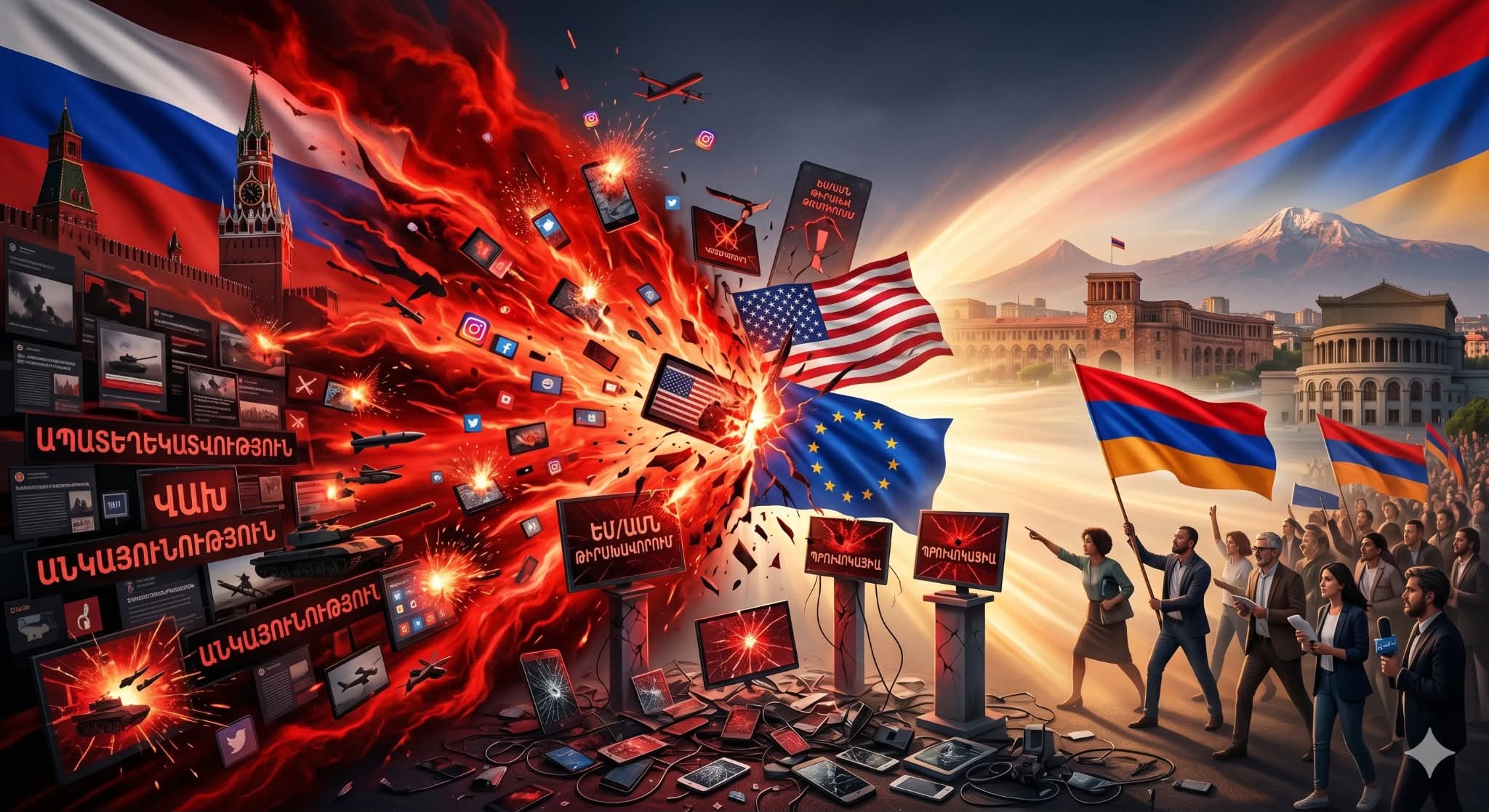

The informational vectors of hybrid attacks are primarily manifested at the level of narratives. At present, one of the most frequently used propaganda “bombs” is the narrative of a potential economic war with Russia. This threat is being widely circulated in the media by pro-Russian forces participating in elections. The aim is to instill fear among Armenian voters, suggesting that Moscow will impose sanctions in the event of Nikol Pashinyan’s re-election, and that for the sake of economic stability it is necessary to vote for pro-Russian forces.
The President of the Russian Federation Vladimir Putin and Deputy Prime Minister Aleksei Overchuk have both indirectly indicated that continued rapprochement between Yerevan and the European Union could entail negative economic consequences. This theme is extensively exploited by pro-Russian political actors and media outlets, with the aim of influencing voters through fear-based messaging. This form of propaganda is used to spread alarm and anxiety. It is a classic example of a hybrid attack, allegedly coordinated from the Kremlin and implemented through Armenian media and political circles aligned with it.
In parallel, there is an ongoing effort to delegitimize the United States and the European Union, portraying them as actors who, in pursuit of their own interests, allegedly use Armenia as a forward base against Russia and as a site of confrontation. The visit of the European hybrid threats response team to Armenia served as a litmus test in this regard. The same pro-Russian political forces, which are themselves involved—directly or through affiliated media actors—in hybrid influence operations against Armenia, accused the EU of interfering in Armenia’s domestic political affairs.
The central “strike narrative” of hybrid attacks is, undoubtedly, the propagation and entrenchment of theses concerning the “Turkification” of Armenia and the idea that Armenia is “fulfilling all of Azerbaijan’s demands.” This narrative is widely employed to support pro-Russian forces ahead of upcoming elections.
In order for these forces to succeed, public opinion is subjected to systematic probing, with the aim of embedding pro-Russian theses into the public consciousness. These forces present themselves as “national” and “patriotic.” The main objective is to obscure the fact that they serve a Kremlin-aligned agenda. On the surface, they promote patriotic ideas; however, in practice, it becomes evident that in order to realize these supposedly “noble national goals” and avoid concessions, the restoration of Russian influence is presented as necessary, particularly in the context of the Armenia–Azerbaijan peace process and regional de-blocking initiatives.
In the Implementation of This Political Engineering Process
In the implementation of this political engineering effort, the pro-Russian segment of Armenia’s media landscape is actively utilized, which receives financial inflows from pro-Russian political forces. In addition to simplistic fake news and disinformation operations, narratives are being advanced that promote the restoration and consolidation of Russian influence.
In one formulation, the message is as follows: “In order for national and patriotic forces to restore the violated dignity of Armenians, it is necessary to re-establish disrupted relations with Russia, and through this we will achieve dignified peace by pressuring Azerbaijan and Turkey.” It is clear that this implies the continuation of a conflict-driven and war-oriented logic. The dissemination of such narratives aims to steer Armenian voters toward pro-Russian political forces, and, in effect, toward an agenda of restoring Russian influence. The media environment and social networks serve as key instruments in the implementation of this strategy.
Through the use of artificial intelligence, content is being generated that discredits the Armenian government, casts doubt on the achievements of cooperation with the European Union and the United States, and promotes Russian state interests.
Hybrid threats, accompanied by media operations, manifest in real-life political processes as a classical case study.
Following the 2020 Nagorno-Karabakh War and the depopulation of Nagorno-Karabakh, instruments of Russian hybrid influence have become increasingly aggressive. The creation of an atmosphere of fear and instability remains one of the primary objectives. Through both media channels and pro-Russian “talking heads,” the narrative that Armenia cannot survive as a state without Russia continues to be actively promoted.
The toolkit of hybrid operations was actively tested in the aftermath of the 2020 war and is now being deployed in a more refined form during electoral cycles. Beyond disinformation, hybrid attacks also manifest in real-world political actions. Exploiting the shock and trauma of the 44-day war, the pro-Russian opposition organized numerous street protests demanding government resignation. Even while Azerbaijan was carrying out military aggression against Armenia and Nagorno-Karabakh, opposition forces took to the streets to call for the government’s resignation, effectively attempting to exploit a deteriorating security environment for political change.
On September 19–20, 2023, protesters gathered in Republic Square in Yerevan threw stones, bottles, and eggs at the Government building. Some attempted to storm the building, leading to clashes with police during which stun grenades were used. During the protests, vehicles were damaged and windows of government buildings were broken.
At the very moment when the Armenian population of Nagorno-Karabakh was being forcibly displaced, demands for regime change were being voiced in the center of Yerevan through aggressive methods. During those days, the police detained hundreds of individuals on suspicion of mass disorder and violence against public officials. These actions aimed at generating chaos in Armenia fully correspond to the logic of hybrid attacks.
These demonstrations were broadcast live both by local pro-Russian and Russian state media outlets, with coverage from RT (Russia Today) even being rebroadcast in Baku. Opposition-pro-Russian media extensively covered these events not as neutral observers, but as direct stakeholders in the developments, and at times even as actors contributing to their escalation.
Hybrid Attacks from Within: The Use of Armenian Media and Political Actors
Some variants of Kremlin-led hybrid threats are nearly invisible, and therefore particularly dangerous. Armenian society is generally familiar with Russian propagandists and, to a large extent, has developed a degree of immunity against openly anti-Armenian narratives. However, the public remains far more vulnerable to the dissemination of false, evidence-free pro-Russian narratives when they are transmitted through Armenian media and political actors.
People, by instinct, tend to trust their compatriots, those who speak their language, or journalists they are accustomed to, more than foreign propagandists. The delivery of disinformation through local media is therefore significantly more effective, as it is not perceived as “hostile propaganda,” but rather as an “alternative opinion” or even a “harsh truth.” Russian propagandists often make crude mistakes due to a lack of understanding of the local Armenian context. In contrast, domestic actors promoting pro-Russian narratives are familiar with the sensitive points of a society shaped by war and national trauma. The danger lies in their ability to package disinformation in emotionally charged language that immediately resonates with the public.
For instance, contacts between Armenian leadership and Turkish or Azerbaijani officials are frequently portrayed as manifestations of “Turkification” or “capitulation.” Since August 8, Armenian pro-Russian media outlets have been saturated with alarmist narratives claiming that the so-called “Trump Route” would sever ties with Iran and function as a “Turan corridor,” that Armenia would use US-purchased drones to spy on Iran, or that the West is seeking to use Armenia against Iran and Russia.
According to a survey conducted between February 3–13, 2026, 24% of Armenia’s population fully supports the “Trump Route” project, while 20% partially supports it. At the same time, 34% are categorically opposed, and 13% are partially opposed. 7% of respondents believe that the main drawback of the TRIPP implementation could be the risk of losing Syunik.
According to the same institute’s findings, Russia is perceived as Armenia’s number one political partner (43%), even ahead of the United States (42%). This comes at a time when, through US mediation, Armenia has initialed a peace agreement with Azerbaijan, and through the “Trump Route” project with the United States, it has an opportunity to pursue regional connectivity without undermining its sovereignty.
The phenomenon of Russia being perceived as the primary political partner can be partly explained by a “post-colonial syndrome,” in which a former dependent entity hesitates to fully detach itself, especially when internal actors and media continuously reproduce pro-Russian narratives. There are numerous instances in which media outlets generate panic through sensational headlines, often citing Turkish sources, claiming that “mosques will be built in Armenia by Erdogan’s order,” that “Armenia is becoming Turkified as it moves away from Russia,” or that “the settlement of 300,000 Azerbaijanis in Armenia is under discussion.”
This informational-propaganda offensive aims to obstruct Armenia’s pursuit of an independent foreign policy and to generate societal fears regarding rapprochement with the European Union, portraying it as “reckless anti-Russian behavior” that could lead to the “Ukrainization” of Armenia. This is not only a pressure mechanism targeting public consciousness but also an instrument designed to constrain the government’s pro-European policy choices.
Independent Media as a Pioneer in Countering Hybrid Threats
Independent media outlets—outside the pro-Russian media sphere—are few in number, yet they play a critical role today in strengthening the resilience of the state. While media channels serving a pro-Russian agenda disseminate manipulative and misleading information, independent outlets attempt to expose fake news and narratives, dismantling the false and fabricated “arguments” underpinning them.
Fact-checking platforms operating in Armenia perform an essential function by deconstructing disinformation and clarifying both its origins and intended purpose. Confronted with waves of disinformation, Armenian society has begun to develop the ability to distinguish fact from manipulation. Although media literacy is still not at a sufficient level, it is nonetheless possible to observe that, thanks to the work of independent media and experts, society has developed a certain “immune system” against informational threats.
At the same time, independent media counter pro-Russian false narratives by advancing sovereignty-centered, state-oriented narratives that emphasize Armenia’s potential in partnership with the West and the non-contradictory, complementary relationship between democracy and security.
During times of hybrid warfare, journalistic ethics becomes a matter of national security. Media must remain independent, yet there is a need for a certain level of coordination with the state in strategic communication, especially during crisis situations. This does not imply censorship; rather, it presupposes ensuring the reliability and timely dissemination of information. Unfortunately, there is currently inconsistency and disorder in this regard.
Russian hybrid attacks aim to erode the will of Armenian society and undermine its confidence in the country’s future. The media stands at the frontline of this struggle. Only a free, professional, and media-literate information environment can withstand attacks targeting Armenian statehood.
How the Russian hybrid war against Armenia will unfold remains to be seen; its outcomes will become visible in the early morning of June 8. However, given the long-term nature of Russia’s strategic interests and its entrenched objective of keeping Armenia within its sphere of influence, such threats are likely to persist.
Armen Harutyunyan