
One of the most controversial statements in Armenia’s recent domestic political discourse was made by Nikol Pashinyan. According to him, if the incumbent authorities fail to secure a constitutional majority and the main opposition forces come to power, a new war could break out as early as September.
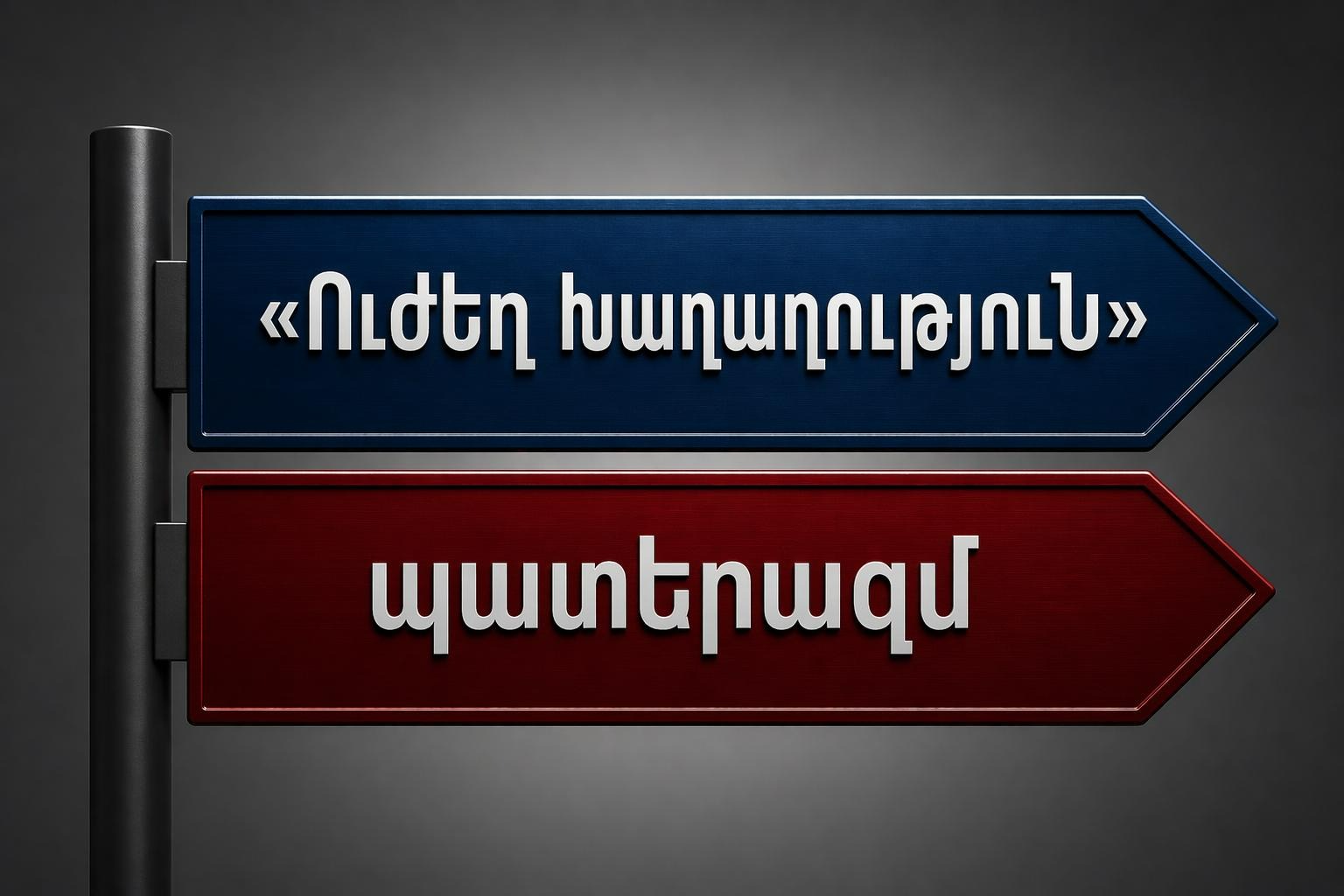
This claim was interpreted by some as an attempt to intimidate voters and exert pressure on them. In this context, this article seeks to analyze several key foreign policy narratives advanced by two of the main opposition forces—Strong Armenia Party and the Armenia Alliance—and to address the following question: could the policy line they propose realistically reverse the Armenia–Azerbaijan negotiation process and lead to a new escalation?
The main actors within the opposition camp state that they, too, support peace. At the same time, however, they argue that the current situation either does not constitute peace at all or represents a weak and undignified form of peace. Their rhetoric revolves around several core narratives: characterizing the current government’s policy as “defeatist” and “treacherous,” emphasizing the absence of credible security guarantees, and promising a reversal of the situation through the emergence of a “strong leader.”
Some commentators argue that the opposition has not indicated any intention to revise the existing Armenia–Azerbaijan agreements; therefore, claims that a change of power would lead to war are unfounded.
However, a closer examination of the discourse of the two opposition forces points to a different conclusion. Their rhetoric reflects an intention to fundamentally revise the outcomes of the negotiation process—an approach which, as shown below, carries a risk of renewed escalation.
For example, one of the Strong Armenia Party’s campaign videos depicts a future scenario (set in 2050), in which a teacher explains to students that Armenia once lost Artsakh due to a “weak leader.” When a student asks how the situation later changed, the teacher replies that everything shifted after the election of a strong leader, under whom the country became strong and secure. In the same video, the map of Armenia displayed on the classroom’s electronic board includes the former Nagorno-Karabakh Autonomous Oblast along with the seven adjacent districts.
In other words, through this campaign video, the Strong Armenia Party advances the narrative that if it comes to power and Samvel Karapetyan becomes prime minister, then, over time, the former Nagorno-Karabakh Autonomous Oblast and the seven adjacent districts of Azerbaijan would become part of Armenia. This implies that Strong Armenia does not accept the reality that the parties have recognized each other’s territorial integrity.
Narek Karapetyan, the top candidate on the Strong Armenia Party’s electoral list, articulates one of their key positions: they are prepared to accept a peace agreement, but not in a purely bilateral format. As he states: “We agree with the TRIPP format, we agree with the text of the agreement; the only difference is that we want additional guarantees. A document signed only with Ilham is not enough for us. We need an agreement that, in addition to Armenia and Azerbaijan, includes other signatories—so that we have the ability to preserve our territorial integrity. That is what constitutes real peace.”
A similar position is expressed by Robert Kocharyan, leader of the Armenia Alliance: “We support peace with Azerbaijan, but that peace must be based not on a ‘trust me’ model, but on real guarantees. This is especially important at a time when the primacy of force has replaced the primacy of law in the world.”
At first glance, this approach may appear to be a logical effort to strengthen security and peace. In practice, however, it implies revisiting or delaying already achieved—or nearly finalized—agreements, which could ultimately produce the opposite effect by undermining security.
First, Azerbaijan has consistently rejected the involvement of third parties. Accordingly, advancing such a proposal would amount to departing from the agreements already reached.
Second, the major regional actors that the Strong Armenia Party seeks to involve as guarantors are in direct confrontation with the United States, which is both a witness to the Washington agreements and a participant in the TRIPP framework. Their involvement would therefore undermine the feasibility of TRIPP and risk extending U.S.–Russia and U.S.–Iran rivalries into the region.
In other words, the idea of “adding more guarantors” is, on the one hand, effectively equivalent to reopening the negotiation process—even if it is presented as “not starting from scratch.” On the other hand, this approach risks generating new instability.
The position of the Armenian Revolutionary Federation (Dashnaktsutyun), a key force within the Armenia Alliance, is even more hardline. In particular, Armen Rustamyan, a member of the ARF Bureau, has stated: “For the current authorities, the solution to all security issues lies not in our collective strength, but in defeatism and concessions. Everything is being done to promote this narrative—to weaken our resilience and keep society in a state of helplessness and despair—in order to force acceptance of what is presented as ‘peace’ under humiliating terms. In reality, this ‘peace’ comes at the cost of Turkification or turning into ‘Western Azerbaijan’—that is, at the cost of abandoning our identity.”
These statements make it more than clear that the Armenian Revolutionary Federation does not accept the peace agreement and views the current realities as subject to radical revision.
In a speech published on the ARF’s official website, Ashot Danielyan—presented as the Speaker of the National Assembly of the Republic of Artsakh and Acting President—advances the following key positions:
● The issue of Artsakh should be returned to the international agenda,
● Support should be provided to the state institutions of Artsakh,
● The notion of the “return of the homeland” should be actively promoted.
For his part, Robert Kocharyan, leader of the Armenia Alliance, has stated: “TRIPP is an Armenian-American project for Azerbaijan and Turkey.” He has also remarked: “What has the Prime Minister of Armenia obtained? A single photograph bearing President Trump’s signature, and a piece of paper with no legal force—one that merely creates another opportunity to mislead the Armenian people.” In another statement, he added: “TRIPP will become our greatest security threat.”
All of the above positions stand in direct contradiction to the current logic of the negotiations, which is based on the mutual recognition of territorial integrity and on treating the Karabakh issue as closed.
If such a political line were to become state policy, it would inevitably imply:
- a shift in the negotiation agenda, which under current conditions would effectively mean the collapse of the negotiation process;
- the reopening of issues that had already been considered closed;
- and, as a consequence, an increase in tensions.
The breakdown of existing arrangements creates a “vacuum,” in which, for example, any border incident could rapidly escalate into a chain reaction of escalation. Moreover, if such statements were ever to become the basis of policy, they could be interpreted by Azerbaijan as evidence of territorial claims and preparations for revanchism, potentially constituting a casus belli, with all ensuing consequences.
What is presented as a “more secure peace” could in reality dismantle precisely those mechanisms that currently ensure at least a state of “no war,” in which even minor incidents have not occurred for a prolonged period. The policy proposed by these opposition figures, even if framed as a “more dignified” or “stronger” peace, in its logic carries a high risk of disrupting the negotiation process and triggering renewed escalation.
Thus, in the upcoming elections, citizens will face the following choice: whether to continue the current process aimed at normalizing Armenian–Azerbaijani and Armenian–Turkish relations, or to shift to a new, more rigid and unpredictable phase, the outcome of which may not be a revised peace, but rather a new war.
Edgar Vardanyan
Associate Expert, “Armenian Council”