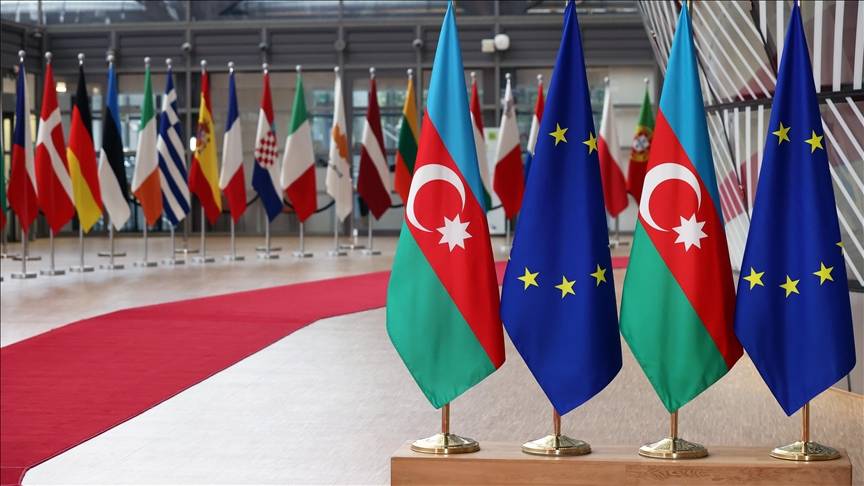

Following the March 11 visit of European Council President António Costa to Azerbaijan, the South Caucasus has once again come to the forefront of European diplomacy. The agenda was largely predictable, focusing on energy cooperation and the development of transport and communication links.
In recent years, the European Union has been seeking alternatives to Russian gas while strengthening ties with other suppliers. Amid the war in the Middle East and ongoing market instability, Azerbaijan’s role for Europe has increased significantly. In this context, Costa’s visit was aimed at strengthening Azerbaijan’s role as a key energy partner of the EU.
Another important message of the visit was support for stability and security in the South Caucasus, as ensuring the security of transport and energy routes remains a critical priority for the European Union.
The Importance of Azerbaijan for the European Union
Although EU–Azerbaijan relations are not formally defined as strategic, in practice they are strategic in nature and differ significantly from Brussels’ engagement with other Eastern Partnership countries. These relations can be characterized not as value-based, but as transactional.
First and foremost, the EU views Azerbaijan as a supplier of energy resources and as an important component of its strategy to diversify energy sources. Following the signing of the 2022 Memorandum of Understanding on a Strategic Energy Partnership, Azerbaijan has significantly increased gas exports to the European Union. Today, ten EU member states receive gas from Azerbaijan. The European market accounts for half of Azerbaijan’s total gas exports, and Baku plans to increase production and exports by expanding the capacity of the Southern Gas Corridor to 20 billion cubic meters annually by 2027. Discussions are also underway in Brussels on easing gas import regulations, which could simplify the conditions for supplies from Azerbaijan.
Azerbaijan is also viewed within the EU as a potential source of alternative energy. Opportunities for cooperation in renewable energy and the “green economy” are being explored. In 2022, the leaders of Azerbaijan, Georgia, Romania, and Hungary signed an agreement on the construction of a submarine electricity cable under the Black Sea. Azerbaijan plans to develop 6–8 GW of renewable energy capacity for export within the next five to six years, while the European side is supporting the development of the necessary infrastructure.
Another key factor increasing Azerbaijan’s importance for Brussels is transport and connectivity. Azerbaijan serves as a central link in the “Middle Corridor,” connecting Europe with Central Asia and China. Its role becomes particularly important in the context of instability affecting northern and southern routes. This route is approximately 2,500 kilometers shorter than the Northern Transport Corridor and can reduce transit times for freight trains from China to Europe by 5–7 days.
In January 2026, the European Union and Azerbaijan agreed to strengthen their partnership within the framework of the EU Global Gateway initiative, including launching a feasibility study for the development of the Nakhchivan railway project.
At the same time, the importance of Central Asia for the EU is growing, and Azerbaijan is increasingly viewed as a connecting link, both geographically and in civilizational terms. In 2025, Azerbaijan became a full participant in the consultative meeting format of Central Asian heads of state.
Whereas the South Caucasus was not previously considered by the EU as a unified region, Brussels is now increasingly prepared—particularly in the context of unblocking regional communications—to view it not only as a unified region, but also, together with Central Asia, as part of a broader geopolitical space. In this regard, both the opening of the Armenia–Azerbaijan and Armenia–Turkey borders and the unblocking of transport links, as well as the normalization of relations between Brussels and Tbilisi, are equally important.
Given the strategic importance of EU–Azerbaijan cooperation, Brussels has for years treated issues such as democracy, human rights, and institutional reforms in Azerbaijan as secondary—areas that have been of primary importance in its engagement with other Eastern Partnership countries.
The Role of the European Union in Azerbaijan’s Foreign Policy
The European Union, for its part, is also one of Azerbaijan’s key partners. It is the country’s largest trading partner and the main source of foreign investment. A significant share of Azerbaijan’s exports, particularly crude oil and natural gas, is directed toward European markets. In January of this year, 50 percent of Azerbaijan’s total trade turnover was accounted for by trade with the EU.
Exports of energy resources to the EU provide Baku with a stable market, long-term contracts, and strengthen the country’s geopolitical position. Cooperation with the EU in transit also contributes to increased revenues and reinforces Azerbaijan’s role as a regional transport hub. Another important area is EU investment in Azerbaijan’s transport, energy, and digital infrastructure.
For Azerbaijan, the EU is also an important partner in the field of demining. Within the framework of the Team Europe Initiative, the EU and its member states make a major contribution, allocating a total of €23 million. However, from Baku’s perspective, this level of funding remains insufficient, and increasing it is a priority.
Despite close economic cooperation, Azerbaijan has never seriously considered EU membership or deep integration, unlike other Eastern Partnership countries (excluding Belarus), and has instead pursued a policy of balancing between different centers of power.
The existing framework agreement between Azerbaijan and the EU is relatively outdated. The Partnership and Cooperation Agreement was signed in 1996 and entered into force in 1999, and no longer reflects current political and economic realities. In recent years, the parties have been working to update this framework and conclude a more comprehensive agreement. Formal negotiations began in 2017, and the future agreement is likely to include elements of cooperation in the field of security and defense.
Azerbaijan’s reluctance toward deeper integration with the EU became evident already in the 2010s, when other Eastern Partnership countries (excluding Belarus) moved toward signing Association Agreements with the EU, while Armenia ultimately signed the Comprehensive and Enhanced Partnership Agreement in 2017. In contrast, in Azerbaijan, such a model of deepening relations has been viewed as asymmetrical.
The Importance of Armenia–Azerbaijan Normalization from the EU’s Perspective
Following the 44-day war, the European Union demonstrated a certain degree of engagement in facilitating dialogue between Armenia and Azerbaijan and sought to assume a mediating role. However, despite EU efforts in 2021–2023, these did not yield tangible progress. During this period, Russia was also gradually pushed out of the negotiation process, and the dialogue continued largely in a bilateral format—up until August 8, 2025, when a peace agreement was initialed in Washington.
Despite the involvement of the United States, and of President Donald Trump personally, the process has remained largely bilateral. As such, it is difficult to envisage a significant EU mediation role in consolidating peace. At the same time, the European Union can become an important partner in border delimitation and demarcation, in the construction of highways and railways through northern Armenia, as well as in the broader unblocking of the region and the establishment of economic ties.
A stable regional environment would facilitate long-term energy projects linked to gas supplies to Europe via the Southern Gas Corridor. A peaceful environment would also make the region more attractive for EU investment. Moreover, through its involvement in peacebuilding and economic projects in the South Caucasus, the European Union is able to maintain its presence and compete with the United States, Russia, Turkey, and China.
Conclusion
Thus, the establishment of sustainable peace between Armenia and Azerbaijan, the development of economic ties, and the unblocking of transport routes would benefit not only Armenia and Azerbaijan, but also the European Union, as Brussels’ economic and infrastructural interests are directly linked to stability in the South Caucasus.
The normalization of Armenia–Azerbaijan and Armenia–Turkey relations, as well as the establishment of trilateral cooperation between Armenia, Georgia, and Azerbaijan, would open new opportunities for the EU in the region. Therefore, it is important for the parties to identify overlapping interests and build cooperation around them.
Varduhi Harutyunyan, International Relations Specialist
Sources
https://www.europarl.europa.eu/RegData/etudes/BRIE/2025/779170/EPRS_BRI%282025%29779170_EN.pdf