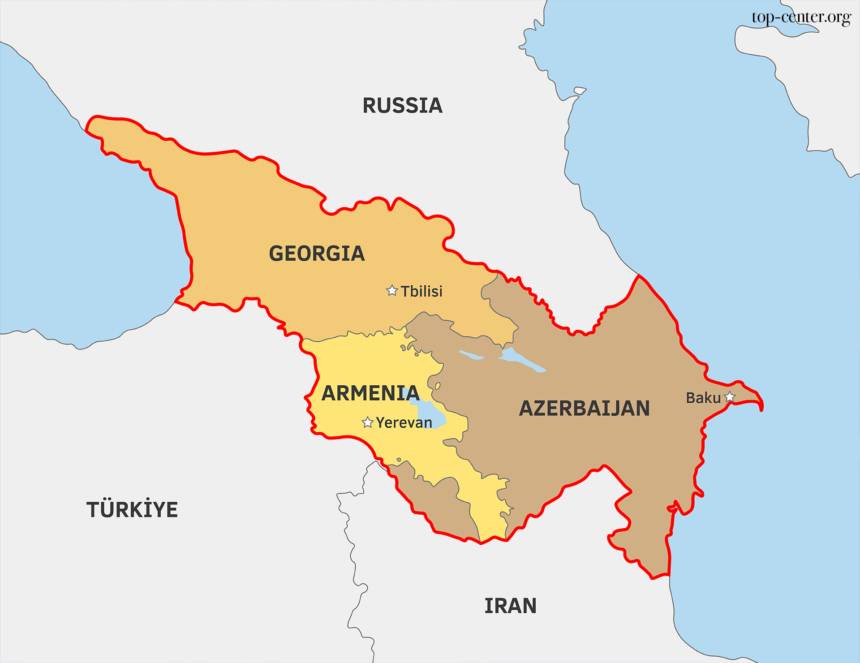

On January 14, 2026, the Minister of Foreign Affairs of the Republic of Armenia, Ararat Mirzoyan, and U.S. Secretary of State Marco Rubio signed a framework document outlining the parameters of TRIPP. The document sets out what TRIPP will look like in practical terms and clarifies the visions, objectives, and interests of Armenia and the United States within this project. Although the framework document does not carry legally binding force, even at this stage it makes it possible to envisage how the Washington agreements of August 2025 will be implemented in political and technical terms.
Two groups of political objectives pursued by the Armenian side can be particularly distinguished. The first relates to the unblocking of the country and its integration into regional and international connectivity projects; the second concerns the protection of Armenian interests and the assurance of sovereignty over the route. The first group also includes the normalization of Armenian–Turkish relations, as well as the strengthening of the strategic partnership with the United States. The formal consolidation of these political objectives constituted an important achievement for the Armenian side, especially given the earlier political discourse surrounding the issue and previously discussed solutions (including within the framework of the November 9, 2020 trilateral statement).
For the American side, the political component implies strengthening regional influence and demonstrating interest in the development of connectivity along the Central Asia–Azerbaijan–Armenia–Turkey–West axis. This is reflected both in the preamble of the document, where TRIPP is described as an important link in the development of the Trans-Caspian Route (the Middle Corridor), and in the section outlining U.S. benefits, which mentions TRIPP’s potential role in facilitating the transportation of raw materials, rare minerals, and rare earth elements.
It should be noted that competition with China—the world’s largest producer of rare earth elements—for access to rare minerals and rare earth metals constitutes one of the priorities of the new U.S. administration. This is reflected both in the activation of political relations with Kazakhstan, which possesses significant reserves and deposits of rare metals, and in the growing U.S. engagement regarding Greenland, whose reserves are estimated to be second in the world after China’s. In this context, a certain logical consistency can be observed in the foreign policy approach of the new U.S. administration across different regions.
An additional argument supporting the view that the United States considers TRIPP not merely within the narrow framework of Armenian–Azerbaijani normalization, but also as an important element in the transportation of resources from Central Asia through Armenia and Azerbaijan, is the invitation extended to the leaders of Armenia, Azerbaijan, Kazakhstan, and Uzbekistan to the ceremony initiating the “Peace Council” proposed by Donald Trump.
In the same context, it is important to note that although the new U.S. administration has demonstrated a lower inclination toward confrontation with Russia and has even sought to reach a broader geopolitical understanding with Moscow—including a potential deal regarding Ukraine and related disagreements with European allies—the emerging logic of U.S. relations with Armenia, Azerbaijan, and the Central Asian states (TRIPP, the 5+ format, Kazakhstan’s accession to the Abraham Accords, etc.) reflects a longer-term and more comprehensive American strategy. This dynamic will inevitably contribute to a weakening of Russia’s influence in the post-Soviet space and to an intensification of geopolitical competition with Russia, even if that is not the administration’s explicitly declared objective.
So far, the Russian response has been largely limited to intensified unofficial propaganda attacks and threats voiced by prominent commentators. These statements, directed at post-Soviet states, are grounded in the thesis of “limited sovereignty” for these countries and include implicit or explicit military threats.
Practical and Technical Solutions within TRIPP for Transit from Mainland Azerbaijan to Nakhchivan
The published document contains important provisions outlining possible practical and technical solutions to what has become the most sensitive and problematic issue in Armenian–Azerbaijani relations following the effective closure of the Karabakh issue. This concerns transit from mainland Azerbaijan to the Nakhchivan Autonomous Republic through Armenian territory—an issue that has been at the center of interstate tensions in recent years and has been framed in Azerbaijani political discourse under the controversial term “Zangezur corridor.”
Prior to the leaders’ meetings in Abu Dhabi (July 2025) and Washington (August 2025), the Azerbaijani side’s demands centered on privileged access arrangements—either in the form of an extraterritorial connection or solutions that would transfer sovereign and security functions, as inherent attributes of the Republic of Armenia, to a third party—without corresponding reciprocal obligations or benefits for the Armenian side. The logic of those demands corresponded to the classic zero-sum game model.
The Washington Agreement and the Framework Document enshrined a number of key principles that enable effective solutions to a politically and geographically complex issue, linked both to the legacy of the conflict and the unique political geography of the South Caucasus (including the existence of the Nakhchivan exclave, through which a more suitable route connecting mainland Armenia with southern Syunik would also pass).
These solutions can be summarized in three main points:
- Sovereignty over the route.
- Security functions.
- Customs and other border procedures.
The question of Armenia’s sovereignty and authority over TRIPP communications is repeatedly emphasized throughout the document in various contexts, leaving no room for debate or discussion regarding extraterritorial corridors or other similar claims.
The implementation of security functions—including the right of entry for all relevant Armenian security and law enforcement agencies along the entire TRIPP route—is the second key point, reinforcing the principle of sovereignty and Armenian jurisdiction. In this regard, the presence of foreign security forces in the area, particularly Russian border guards along the TRIPP route, is problematic. This is especially relevant for railway segments that pass almost entirely through the border zone, falling directly under the responsibility of the Russian FSB Border Service. Beyond geopolitical tensions and associated risks, such circumstances create a direct conflict with the fundamental principle enshrined in the document: the authority of Armenian law enforcement and security agencies over the territory, where the presence of another country’s forces could compromise sovereignty. Furthermore, this situation may give rise to other undesirable incidents, one of which was recently addressed1.
The principle of sovereignty and Armenian jurisdiction is also maintained in customs and other border procedures. The document codifies principles and solutions that the Armenian side had proposed as early as 2022 for transit from mainland Azerbaijan to Nakhchivan, using a front office / back office model. In this model, an international company provides front office services—document verification, information provision, payment collection, etc.—meaning that interactions occur at the human-to-human level.
It is also important to highlight the framework document’s provision regarding differentiated procedures depending on the type and category of the border-crossing entity, which is codified under Armenia’s obligations:
“Develop differentiated procedures for individuals, vehicles, and goods, including for communications between mainland Azerbaijan and the Nakhchivan Autonomous Republic in both directions, in accordance with all Armenian laws, normative acts, and international agreements, and in line with international standards.”
This means that the regulation of transit from mainland Azerbaijan to Nakhchivan and vice versa—both for goods and for people—as well as international transit, must be differentiated; that is, the procedures should not be identical.
A particularly important practical aspect of the framework document lies in its final section, which establishes principles aimed at simplifying and accelerating border-crossing procedures. This is especially significant in the context of connectivity between mainland Azerbaijan and the Nakhchivan Autonomous Republic and can also secure reciprocal advantages for the Armenian side when transit occurs through Nakhchivan.
Among the technical solutions facilitating border crossing, the framework highlights:
- Pre-customs clearance;
- Digitalization of document circulation;
- Implementation of a “single window” principle;
- Technology-assisted risk assessment;
- Coordination with neighboring states.
The last point implies that the Armenian and Azerbaijani sides must develop operational communication and cooperation mechanisms in this area, including data exchange, to maximize the speed and simplicity of the border-crossing process.
We believe that the Armenian side should already begin developing technical and other solutions with the Azerbaijani side at this stage. This will allow for a clear understanding of the other side’s needs and perspectives while enabling Armenia to define its own framework of reciprocal interests regarding transit through Azerbaijani territory.
A willingness to adopt flexible solutions and account for reciprocal interests in this model will significantly ease communication between the Nakhchivan Autonomous Republic and Azerbaijan. It will also make similar transit through Nakhchivan faster and more efficient for Armenia.
The TRIPP project’s solutions serve as a precedent. As noted in one of my articles on Nakhchivan’s role, unlocking this territory for Armenia and Azerbaijan’s domestic and international connectivity can significantly enhance the region’s overall transport and communication potential.
Azerbaijan’s previous demand for unhindered access to this territory—rooted in the legacy of a highly contentious conflict, complex political geography, and mistrust toward Armenia—has, with the involvement of the United States and the emergence of the TRIPP agreement, been transformed into a precedent and model. Here, the preservation of principles of international law and state sovereignty, aimed at facilitating and accelerating regional connectivity, is combined with the possibilities offered by modern and effective technical solutions.
The need for continuous engagement between the parties, along with the consideration of reciprocal interests in these solutions, could create a functioning institutional platform within which a future regional integration model—under an Armenia–Georgia–Azerbaijan format—can be tested. The practical solutions implemented under TRIPP could later be applied to other border sections and checkpoints between Armenia and Azerbaijan, Armenia and Georgia, as well as Georgia and Azerbaijan. If these solutions are not implemented in the trilateral format in the near future, it is important that individual elements be operationalized within the developing bilateral formats between the countries.
We believe that, under a constructive and pragmatic political framework, transforming one of the region’s most sensitive issues—for the Armenian side, still referred to as the “Zangezur corridor”—could serve as both a source of development and a testing ground for regional integration models, while simultaneously representing an important symbolic step on the path toward the transformation of the entire South Caucasus.