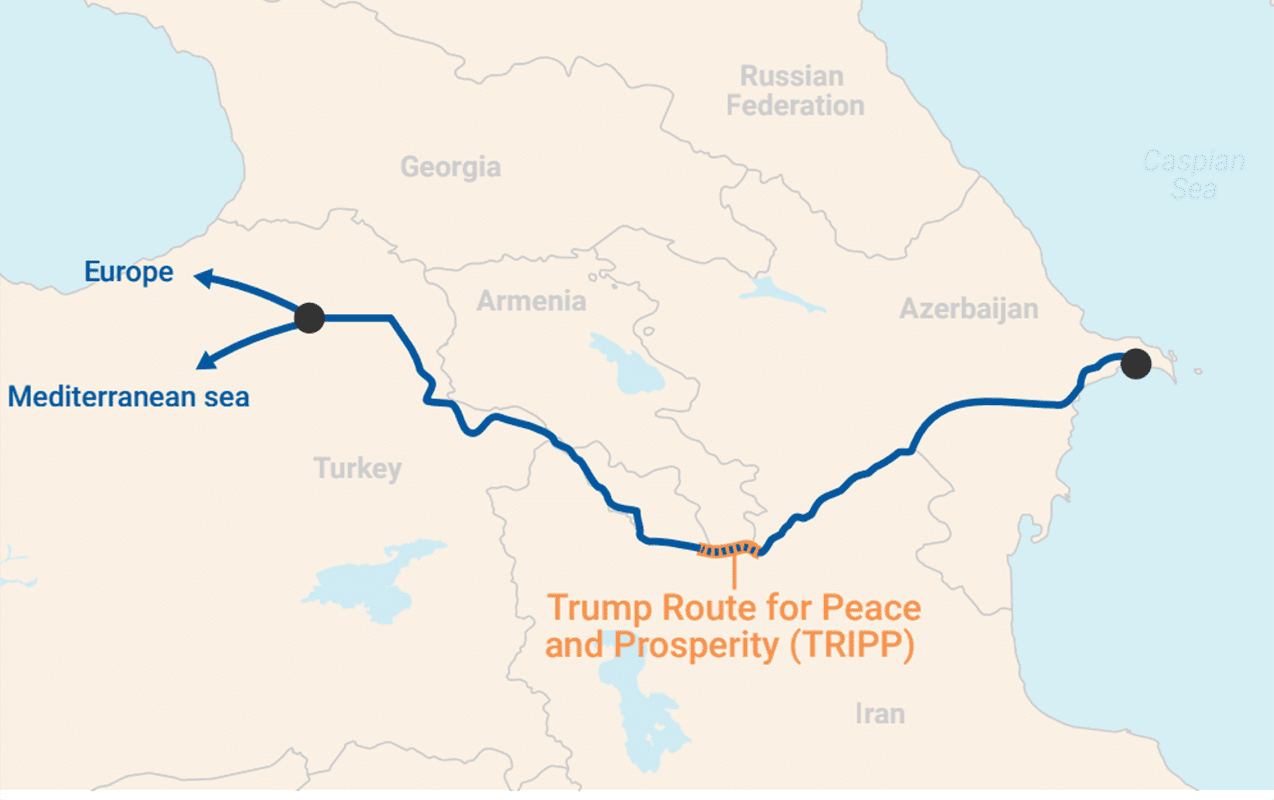

On January 14, a meeting took place in Washington between the Minister of Foreign Affairs of Armenia and the United States Secretary of State, following which the implementation framework of the project titled “The Trump Path for International Peace and Prosperity” (TRIPP) was published.
The adopted joint statement is of great significance, as it effectively documents all the details and regulatory arrangements related to the implementation of the project.
This article addresses the importance of the statement and the next steps.
The Significance of the TRIPP Statement
The statement adopted by the Armenian Ministry of Foreign Affairs and the U.S. Department of State is important for several reasons.
First, the adoption of the statement moves the implementation of TRIPP into a practical phase. In recent months, political and expert circles in Azerbaijan voiced speculations and concerns claiming that the Armenian side was artificially delaying the process. In reality, the duration of negotiations was primarily due to two key factors: the longest government shutdown in U.S. history (43 days), which paralyzed almost the entire American state system, as well as the involvement of the Office of Steve Witkoff and the U.S. Department of State in the resolution of several conflicts (Gaza, Ukraine, etc.).
The finalization and publication of the document elevate the TRIPP implementation process to a new stage, dispelling all potential concerns. Official Yerevan has already announced that all documentary and legal procedures are expected to be completed in the first half of 2026, with construction works scheduled to begin in the second half of the year.
Although the document does not create legally binding obligations, it will serve as a guiding framework for the formulation of legally binding statutory and founding documents related to the project in the coming months.
The statement is based on the principles of the Peace Declaration signed in Washington on August 8, 2025—territorial integrity, sovereignty, and jurisdiction. It outlines a concrete roadmap for the operation of TRIPP, designed to establish unobstructed, multimodal transit connectivity through the territory of Armenia. It is expected that TRIPP, by connecting mainland Azerbaijan with Nakhchivan and serving as a vital link in the Trans-Caspian trade route, will create mutual benefits of international and domestic connectivity for Armenia.
Politically, the statement sends a clear signal that the United States is committed to assuming a more active role in the South Caucasus and supporting the Armenia–Azerbaijan peace process. At the same time, it reaffirms Washington’s support for Armenia’s territorial integrity and sovereignty, forming an important foundation for long-term regional stability.
Economically, TRIPP represents a mutually beneficial arrangement between Washington and Yerevan. It opens new markets for U.S. investments, businesses, and goods, enhances access to regional resources, and ensures alternative trade routes between the United States, Europe, and Asia. For Armenia, it offers unprecedented opportunities for infrastructure and institutional development, as well as investment growth.
Notably, the document situates TRIPP within a regional context as a vital link in the Trans-Caspian trade corridor. This is particularly significant in light of the recent U.S.–Central Asia summit held in Washington, where the parties agreed to deepen cooperation. The advancement of TRIPP also sends a message to U.S. regional and international partners to view it as a preferred route connecting Central Asia to Europe.
Implementation Framework and Ownership Structure
The cooperation timelines under TRIPP are also noteworthy. In accordance with Armenian legislation, a TRIPP Development Company will be established to implement the project. Armenia will grant the company development rights for an initial period of 49 years. Of the company’s shares, 74% will belong to the United States and 26% to Armenia.
A 49-year term is not exceptional for international infrastructure projects of this scale, as it is necessary to ensure the return on large investments.
The distribution of shares reflects the proportional investments planned by the United States and Armenia. Armenia’s contribution includes the granting of development rights within transit routes, existing infrastructure assets, regulatory support and expedited permitting procedures, investments in border and customs infrastructure, as well as potential cash contributions if necessary.
The American side has already expressed readiness to invest several hundred million dollars in developing Armenia’s infrastructure, border, and customs capacities. Armenia has already received $145 million as an initial tranche of assistance.
According to the statement, cooperation under TRIPP may be extended for an additional 50 years, at which point Armenia’s ownership share will increase to 49%.
Despite the share distribution, it is important to emphasize that all matters related to the TRIPP Development Company are subject to agreement between the governments of Armenia and the United States, and Armenia will have a decisive voice on fundamental issues. In addition to revenues corresponding to its ownership share, Armenia will receive taxes, customs duties, and other mandatory payments related to trade and transit under the project.
The Issue of Sovereignty
Following the August summit in Washington, objective and subjective concerns existed within Armenian public and political circles regarding potential regulatory arrangements under TRIPP. The joint Armenian–American statement addresses many of these concerns.
The document clearly and unequivocally states that Armenia’s full sovereignty and jurisdiction over the entire TRIPP corridor are preserved—one of the Armenian side’s primary red lines. It addresses jurisdiction-related issues in considerable detail, emphasizing that no delegation of sovereign functions of Armenian state bodies will take place.
Such detailed emphasis on sovereignty and jurisdiction is crucial for avoiding potential problematic situations during the project’s implementation.
The statement effectively puts an end to speculation regarding the establishment of an extraterritorial corridor through Armenia. Previously, Azerbaijan had circulated various demands, such as the uninterrupted passage of Azerbaijani citizens and goods without stops, exemption from transit fees, and the absence of Armenian presence at checkpoints. None of these extraterritorial elements are present in the Armenian–American statement on TRIPP.
Unobstructed connectivity between Azerbaijan and Nakhchivan through Armenian territory will be ensured through a “front office–back office” mechanism, with facilitation achieved through technologically modernized procedures rather than limitations on Armenian jurisdiction.
Following the agreement between Armenia and the United States on the TRIPP implementation framework, it is also important to consider Azerbaijan’s response. Official Baku has so far limited itself to a brief statement. Azerbaijani Foreign Ministry spokesperson Aykhan Hajizada noted that the adoption of the statement is important for launching practical work toward implementing the agreements reached on August 8, as well as for fulfilling Armenia’s commitments.
In the coming period, alongside the approval of TRIPP-related regulations, Washington and Yerevan will need to begin active discussions with Baku to address practical issues and reach further agreements.
Conclusion
The joint Armenia–U.S. statement on TRIPP moves the project’s implementation into a practical phase. It has the potential to significantly strengthen Armenia’s sovereignty, bring the country out of nearly three decades of blockade, and create unprecedented economic opportunities. It will also provide Armenia with additional political weight and negotiating leverage at both regional and broader international levels.
Narek Minasyan