

Introduction
Two social surveys conducted independently by the International Republican Institutei (IRI) and the Electoral Systems Research Centerii of Armenia (EVN Report) have recently been published. This paper will examine both surveys and attempt to analyze their findings, particularly in the context of the 2026 parliamentary elections.
Before turning to the analysis, it is important to make several observations regarding the methodology of these surveys and to clarify what matters most when interpreting their results.
The International Republican Institute survey (hereafter IRI) was conducted in early February via telephone interviews. The response rate stands at 22%. While the results from that 22% are, within the margin of error, statistically representative, the remaining 78% who did not respond are highly significant for analytical purposes. The large share of non-respondents can be interpreted in various ways—as a reflection of voter behavior, the limitations of telephone survey formats, the absence of clear political preferences, distrust toward surveys and political discourse, or even the existence of a “silent majority.”
The term “silent majority” refers to a large group of individuals whose views and perceptions are not expressed in a structured or public manner and therefore remain largely invisibleiii in social surveys. Its potential presence significantly complicates the assessment of public opinion, including the interpretation of pre-election polling data. At the same time, it is difficult to assert its existence with certainty, as it may only become apparent indirectly—for example, through comparative analysis between polling results and actual election outcomes, or through other forms of research such as qualitative studies (e.g., focus group interviews).
The methodology of the Electoral Systems Research Center of Armenia survey (hereafter EVN) differs somewhat, which makes a comparative analysis of the two surveys particularly valuable. The EVN survey was also conducted via telephone interviews in February. However, its sample size is approximately half that of the IRI survey, and it does not provide information about non-response rates. The analytical value of the EVN survey lies in its attempt to address and build assumptions around the issue of the “silent majority,” while the key strength of the IRI survey is its ability to offer comparisons over time. The EVN study also seeks to estimate the preferences of undecided respondents or those who chose not to answer specific questions.
Here is a careful, natural, policy-style English translation:
Analysis of the Results
In one of our previous papers, we attempted to formulate several forecastsiv regarding the upcoming parliamentary elections. In this section, we will also consider the findings of the above-mentioned surveys within the framework of those projections.
On Voter Turnout
According to the IRI survey, 68% of respondents stated that they had participated in the 2021 parliamentary elections, while 31% reported that they had not. This raises a number of issues and inconsistencies that require closer examination. According to official data, voter turnout in the 2021 parliamentary elections was approximately 49.3%. What might explain such a significant discrepancy, when the survey results diverge so markedly from reality—even taking into account a margin of error of ±2.5%?
One possible explanation is that respondents did not answer truthfully or simply misremembered their participation. Another possibility is that the survey itself is methodologically flawed and not fully representative; in this case, the fact that 78% of those contacted did not respond could indicate that their inclusion might have significantly altered the overall picture, pointing to potential limitations in the survey design.
A third—and perhaps the most plausible—explanation is that actual voter turnout in Armenia may in reality be higher than officially reported figures suggest, due to the fact that the number of active voters in the country is effectively lower than the total registered electorate. At the same time, it should be acknowledged that inaccurate self-reporting by respondents and the relatively wide margin of error may also play a role.
Overall, this issue further reinforces the argument in favor of a higher turnout forecast in the upcoming elections.
Notably, in response to the IRI question regarding the likelihood of participating in the next parliamentary elections, 68% of respondents indicated that participation was “very likely,” while 16% considered it “somewhat likely” (84% in total). This figure is broadly consistent with the EVN survey, where 82% of respondents expressed an intention to participate.
The EVN study also notes that if actual turnout falls below the levels suggested by the survey, the likelihood of support for the incumbent authorities increases. Lower turnout, in particular, tends to be more characteristic of younger voters.
On Public Political Preferences
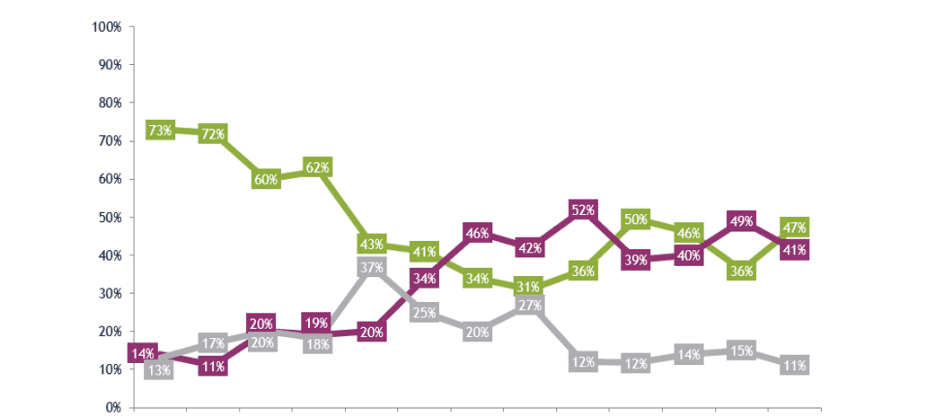
According to the EVN survey, 35% of respondents believe that the country is moving in the right direction, while 38% think it is heading in the wrong direction. In contrast, the IRI survey shows that 47% consider the country to be moving in the right direction, compared to 41% who believe it is moving in the wrong direction.
It is noteworthy that there has been a significant shift in public sentiment since the IRI’s previous survey conducted in June 2025: the gap between perceptions of the country moving in the “right” versus the “wrong” direction has shifted from -11% to +6%.
This change in perceptions, if sustained, is likely to work in favor of the incumbent authorities in the context of the upcoming elections.
According to the EVN survey, among undecided voters, 29% believe the country is moving in the wrong direction, while 26% think it is moving in the right direction.

According to the IRI data, 24% of respondents would vote for the Civil Contract party in parliamentary elections, while 9% would support the Strong Armenia party (Samvel Karapetyan). The next two forces with notable support are Prosperous Armenia and the Armenia Alliance, each receiving 3%.
It is important to note that if running as an alliance, and given such low levels of public support, the Armenia Alliance may fail to meet the 8% electoral threshold required for alliances and thus not enter parliament1.
According to the IRI survey, 30% of respondents remain undecided. The EVN survey data largely mirrors this picture and falls within the margin of error, with the only notable difference being Prosperous Armenia’s 6%, which is also not far outside the margin.
The only clear demographic pattern is the predominance of supporters aged over 56 within the Civil Contract electorate. For other political forces, gender, age, and geographic distribution appear relatively even. The ruling party’s supporters also show a geographic pattern: support is significantly lower in Yerevan (15%) and higher in other urban areas (25%) and rural communities (31%). Nevertheless, even in Yerevan, Civil Contract’s 15% remains the highest level of support compared to other parties, with Strong Armenia following at 10%.
These observations are particularly important in the context of campaign messaging. The most prominent policy proposal of Strong Armenia is the creation of 300,000 new jobs. However, statistical data indicates that the greatest demand for employment is in the regionsv. At the same time, as noted, support for the ruling party is significantly stronger outside Yerevan.
This raises two possible interpretations: either Strong Armenia has made a strategic miscalculation by targeting an electorate where the ruling party holds stronger positions, or this reflects a deliberate tactical choice. In any case, the effectiveness of this approach will ultimately be determined during the campaign and at the ballot box.
It is also important to note that the undecided group is composed predominantly of younger voters, with no clear geographic pattern.
Conclusion
In summarizing this analysis, several key points should be highlighted. Although the survey results are preliminary and still relatively early in the electoral cycle, they nevertheless outline a certain emerging picture.
There is a noticeable level of public interest in the elections and a willingness to participate, despite contrary narratives circulating in public discourse. The primary group characterized by low engagement and indecision consists of younger voters (aged 18–35).
Overall, the dynamics of public opinion appear to be working in favor of the incumbent authorities, who are likely to structure their campaign around maintaining and reinforcing this trend. At the same time, the campaign period will naturally provide other political forces with opportunities to improve their standings—either by attracting undecided voters or by drawing support away from competing electorates.
As the case of Strong Armenia illustrates, the latter approach appears quite realistic. It is also evident that a significant portion of the Armenia Alliance electorate has already been “recaptured,” although it remains unclear which political forces have benefited most from this shift. This will become clearer through future surveys and, ultimately, election results.
The positive trajectory of the ruling party’s approval ratings has also fueled discourse around the possibility of Civil Contract securing a constitutional majority in parliament following the elections. However, this scenario appears unlikely. The reasons for this, along with other related issues, will be addressed in the next set of projections.
Tigran Mughnetsyan