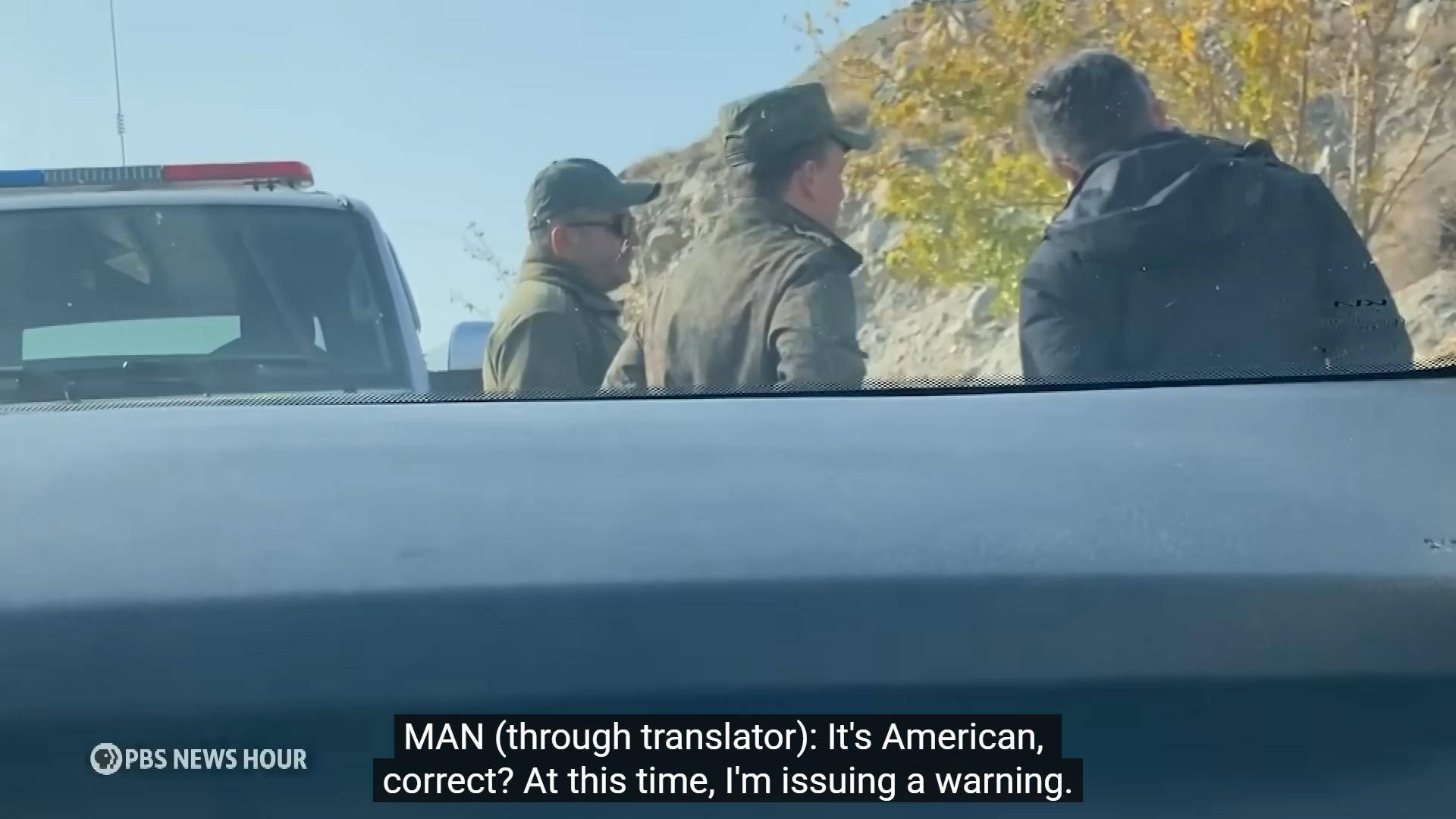

A report on TRIPP was aired during the evening broadcast of PBS News Hour, produced by American journalists during their visit to Meghri in November 2025. While traveling along the TRIPP route on the highway running parallel to the Armenian–Iranian border, the journalists were stopped by a patrol of Russia’s Federal Security Service (FSB) Border Guard Service. The border guards issued a warning to the American reporters, citing a prohibition on filming in the border zone. This episode was included in the segment broadcast by PBS News Hour1.
Moscow has officially stated on several occasions, in the context of TRIPP, that in the areas “where the proposed route is expected to pass,” the presence of Russian border guards implies that Moscow’s interests must be taken into account. This position was articulated on September 12, 2025, during a briefing by Maria Zakharova, the spokesperson of the Russian Ministry of Foreign Affairs, and reiterated in December by Mikhail Kalugin, head of the Fourth Department of the CIS Countries at the Russian Foreign Ministry.
Moscow is leveraging this factor as a political instrument to underscore its interests. Given that this argument has been voiced periodically by senior Russian Foreign Ministry officials, it can be reasonably assumed that it will continue to be employed in the future.
The passage of a strategically important regional transport corridor through the narrow strip of land between the border river Araks and the mountains of Meghri—where Russian FSB border forces are in direct proximity to potential TRIPP communications—creates a number of risks for the Armenian side.
The most extreme scenario involves the creation of artificial obstacles or acts of sabotage aimed at engineering a security crisis along the TRIPP route in order to obstruct its operation. It is important to recall that transit security through Meghri is one of the core issues repeatedly raised by the Azerbaijani side. Problems arising in this context could both exacerbate Armenian–Azerbaijani relations and undermine international investors’ interest in the project.
At the same time, the construction of TRIPP is attracting growing attention from international media, investors, and political actors. The expected increase in activity by foreign correspondentsin the TRIPP construction zone is likely to result in numerous incidents similar to the one involving PBS News journalists. Such episodes clearly have a negative impact on perceptions of the project and damage Armenia’s international image. In a context where Russian security structures are widely associated with aggression against Ukraine, even a limited number of similar incidents covered by international media could lead not only to reputational losses but also to a serious setback in attracting international investment.
Additionally, the Armenian–Iranian border is Armenia’s shortest—only 44 kilometers—and simultaneously one of its most secure from a geographical, technical, and political perspective. Along this section, the rapid current and considerable width of the Araks River, combined with the narrow mountainous valley fully visible from the surrounding slopes, significantly complicate illegal border crossings. Political relations between Yerevan and Tehran are also predictably stable, even under hypothetical scenarios of radical domestic political change in Iran.
The presence of the Russian side on the Armenian–Iranian border constitutes a historical anachronism devoid of justification, one that is also simultaneously capable of generating multiple challenges. At the same time, the use of modern technical surveillance tools could substantially facilitate border protection and patrols, reducing the need for large-scale personnel deployment.
In light of these considerations, it is critically important that, prior to entering the practical implementation phase of TRIPP, Armenian border forces assume full control over the protection of the border with Iran.
_____________________
Samvel Meliksetyan