
Preface
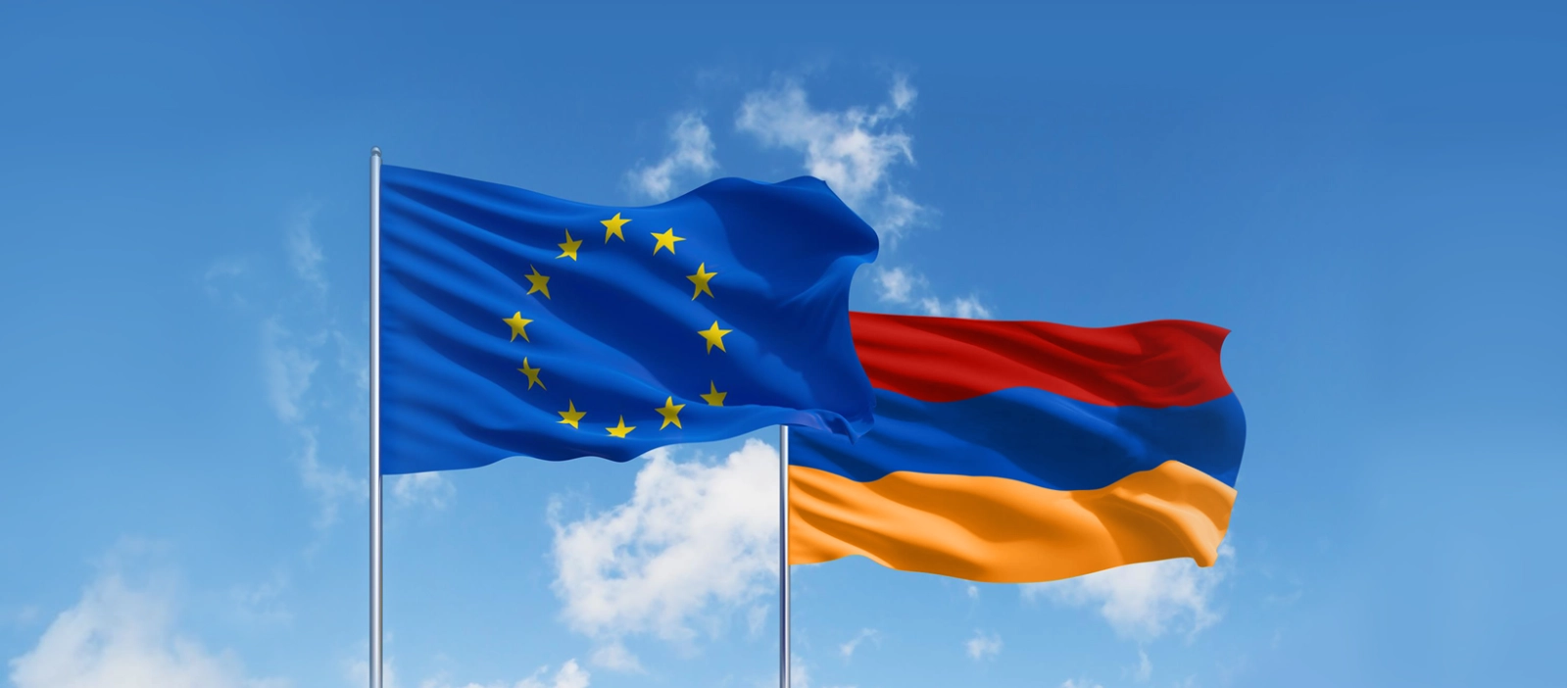
On December 2, the Armenia–EU Strategic Agenda was adopted in Brussels. It complements the Comprehensive and Enhanced Partnership Agreement (CEPA), signed in November of 2017 and fully enforced as of March 2021.
The Armenia–EU Strategic Agenda outlines the overall vision for the coming years and reflects Armenia’s expressed aspiration to strengthen its ties with the European Union.
Review of Priorities
As early as July 1 of this year, when the conclusion of negotiations on a new document between Armenia and the European Union was announced, the official statement referred to it as a “New Partnership Agenda.[i]” By December, the document was published under the title “Armenia–EU Strategic Agenda,” which is highly symbolic and effectively signals the elevation of bilateral relations to a strategic level.
The new document replaces the bilateral partnership priorities established in February 2018, setting a more ambitious and comprehensive framework for joint actions[ii].
The document identifies six main areas of cooperation:
1. Democracy, human rights, and good governance
2. Freedom, mobility, and security
3. Foreign and security policy
4. Economic and sectoral cooperation
5. Trade and related issues
6. People-to-people contacts
Within each area, the parties have outlined short-term (3–4 years) and medium-term (7 years) priorities. While some of these areas are also covered in the CEPA, the Strategic Agenda sets new, more ambitious objectives.
The document also introduces entirely new areas that had not been included in previous bilateral documents. A few of these are highlighted below:
Security and Defense Policy
The new document envisages expanding cooperation in regional security, crisis management, security sector reform, cybersecurity, and countering hybrid threats. Notably, solid foundations for cooperation already exist in this area. Since 2023, the EU Civil Mission has been operating in Armenia, with its mandate extended for two years. In June 2025, Armenia and the EU launched Security and Defense Consultations, which will be held periodically. In 2024, under the European Peace Facility, Armenia received its first assistance package (€10 million), and arrangements for a second package (€20 million) are already in place[iii].
As part of the expanded cooperation in security and defense, the EU plans to provide Armenia[iv] with €15 million to strengthen peace and resilience. These funds will support various initiatives, including training demining specialists, acquiring equipment, and promoting confidence-building measures in the region.
Importantly, the EU has positively responded to Armenia’s request for support in countering hybrid threats ahead of upcoming parliamentary elections. To this end, the EU will allocate €12 million to counter disinformation campaigns, cyberattacks, public opinion manipulation, and attempts to undermine trust in democratic institutions[v].
It is also notable that Armenia intends not only to be a security consumer but also to contribute as a security provider. In this regard, the June agreement on defining Armenia’s participation in EU crisis management operations, ratified by the Armenian Parliament in late November, was significant.
Connectivity
Another new area of cooperation in the Strategic Agenda is connectivity. The document emphasizes supporting strategic investments and initiatives under the “Global Gateway” framework aimed at improving regional interconnectedness, enhancing economic resilience, and opening new opportunities for trade and mobility.
Cooperation in this area also aligns with the EU’s economic interests, given its growing engagement with Central Asian countries and the desire to ensure secure and stable communications. In April of this year, European Commission President Ursula von der Leyen noted that opening the Armenia–Azerbaijan and Armenia–Turkey borders could change the rules of the game and significantly boost EU–Central Asia connectivity[vi].
The EU is ready to provide political, financial, logistical, technical, and expert support for regional unlocking processes. The European Commission is actively engaging with Yerevan and Baku on this matter. Azerbaijan appears to be considering cooperation with the EU on financing the reconstruction of the Nakhchivan railway.
Armenia has yet to finalize its priority projects. Potential EU engagement could include constructing the Yeraskh–Azerbaijan border railway, upgrading the Yeraskh–Akhurik railway, building the Fioletovo–Vanadzor railway, and restoring and modernizing the Dilijan–Ijevan–Azerbaijan border railway.
It is also important that within Armenia–EU cooperation, sufficient attention is paid to strengthening Armenia’s institutional capacity in this sector. Over the years, Armenia has invested insufficiently in training infrastructure specialists. Considering the large-scale infrastructure projects currently underway and planned, this capacity gap may become more acute in the near future.
Energy is another key area of Armenia–EU cooperation under connectivity. Joint efforts are being made to enhance energy links between Armenia, the region, and the EU. Under the “Caucasus Transmission Network” project, the EU will invest €500 million to strengthen Armenia’s energy security and diversification, including connecting Armenia’s electricity grid to Georgia and Turkey.
Trade and Economic Relations
The third area newly highlighted in the Strategic Agenda is trade and economic relations. The parties discussed ways to expand investments in strategic sectors, promote economic diversification, and enhance cooperation in trade, digitalization, green transition, energy security, and climate action.
From the perspective of facilitating Armenian exports to the European market, harmonization of regulatory authorities, modernization of customs procedures, and review of technical and food safety standards are particularly important. Deepening cooperation in these areas could multiply the effects if the Armenia–Turkey border is opened and rail links between Armenia and the EU are established.
Political Significance of the Strategic Agenda
The adoption of the Armenia–EU Strategic Agenda carries substantial political significance and strengthens the institutionalization of bilateral relations.
Whereas relations to date have largely focused on technical reforms, financial support, and sectoral cooperation, the new document commits both parties to shared political responsibility within the framework of a common strategic vision. This is particularly important given the frequent short-term or transactional involvement of external actors in various regions.
Establishing a strategic partnership with the EU enhances Armenia’s foreign policy agency. It also opens new opportunities to deepen bilateral relations with EU member states, including in areas previously considered unattainable.
While the defense agenda does not yet imply a formal strategic partnership, it clearly expands the EU’s political presence in the South Caucasus through Armenia. In this context, the document also serves as a preventive mechanism aimed at curbing potential destabilizing developments.
Azerbaijani Reactions
The adoption of the Armenia–EU Strategic Agenda was met with a rather strong response in Baku, including at the level of the Ministry of Foreign Affairs.
Azerbaijani criticism focused on the security and foreign policy components of the agenda, which Baku perceives as inconsistent with the EU’s claimed neutrality as a mediator. Official Baku has sought to link the Strategic Agenda to the peace process, arguing that it could “disrupt” Armenian–Azerbaijani negotiations. Baku also expressed dissatisfaction over the document not mentioning the “Trump Road,” which is arguably illogical, as the document text was finalized on July 1, while the TRIPP agreement was reached on August 8.
Azerbaijan’s criticism can be explained by several factors:
- Azerbaijan seeks to position itself as a regional hegemon, requiring international actors to coordinate their regional policies with it. This approach has been repeatedly declared at the highest levels, and Baku is now trying to implement it.
- Azerbaijan is not interested in expanding EU presence in the region and therefore views deepening Armenia–EU partnership as a challenge to its strategic interests.
- By criticizing the EU for “bias,” Azerbaijan seeks to strengthen its position in negotiations with the European side, effectively legitimizing expectations for greater financial support related to infrastructure projects, demining, and other initiatives.
Summary
The Armenia–EU Strategic Agenda marks a qualitatively new phase in bilateral relations. It not only reflects the unprecedented dynamics of recent years but also establishes a long-term political and institutional foundation for Armenia’s European choice, foreign policy diversification, and response to regional challenges. The agenda’s success will depend on sustained political will, effective institutional systems, and mutual commitment to developing the EU–Armenia partnership.
Narek Minasyan
[i] chrome-extension://efaidnbmnnnibpcajpcglclefindmkaj/https://www.mfa.am/filemanager/%D5%80%D5%80-%D4%B5%D5%84/Strategic%20Agenda%20for%20the%20EU-Armenia%20Partnership.pdf
[ii] https://www.eeas.europa.eu/node/40181_en
[iii] https://armenpress.am/hy/article/1237886
[iv] https://armenpress.am/hy/article/1236591
[v] https://www.azatutyun.am/a/evramioutyouny-hayastanin-12-mln-evroyi-ajaktsoutyoun-kta-ayd-tvoum-rousakan-apateghekatvoutyan-dem-paykari-hamar/33610696.html
[vi] https://www.azatutyun.am/a/33373893.html