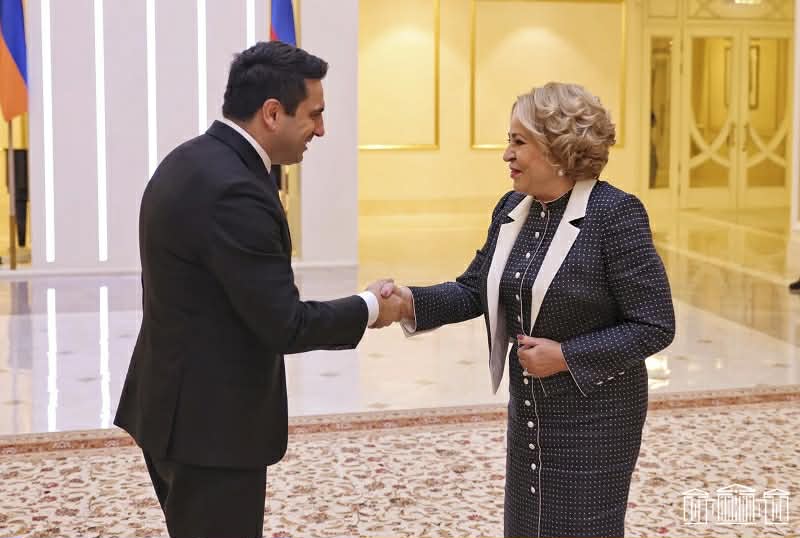

The visit of Armenia’s National Assembly Speaker Alen Simonyan to the Russian Federation sparked considerable reaction in both countries.
First, during the open part of his meeting with Simonyan, Foreign Minister Sergey Lavrov voiced concerns on a number of issues—some of which, notably, already contained their own answers. In particular, Lavrov expressed surprise at the existence of opinions in Armenia suggesting that Russia is conducting hybrid operations against the country. Yet elsewhere in the same remarks, Lavrov once again referred to the alleged impossibility of combining membership in the Eurasian Economic Union (EAEU) with closer integration with the European Union. This reference itself constitutes a hybrid signal—a warning to Armenia that excessive rapprochement with the EU could result in the loss of benefits derived from the EAEU.
Subsequently, the Russian foreign minister addressed the issue of visa liberalization with the EU, referring to the “presence of Russian border guards” on Armenia’s borders, which he described as “Yerevan’s current obligations.” The reality, however, is that following independence it was Armenia that requested Russia to assume these responsibilities for a limited period—services for which Armenia pays, and at a considerable cost. Moreover, Armenian officials have already stated that as Armenia’s own capacities develop, Russian border guards will be replaced by personnel from Armenia’s relevant services.
The joint press conference of Alen Simonyan and the Speaker of the Russian State Duma, Valentina Matviyenko, was also noteworthy. Russian journalists appeared well prepared in advance and posed clearly provocative questions, largely concerning Armenia’s internal political and legal matters. The impression was that Simonyan was responding not so much to Russian media, but rather to questions characteristic of Russian-aligned political forces in Armenia’s opposition field and the media outlets created and financed by them.
Armenia’s former vassal-like dependence on Russia is now a thing of the past. Evidence of this reality can be found in the discourse of Armenian officials at high-level meetings, which no longer confines itself to justifying or accommodating Russian concerns, but—within the bounds of diplomatic ethics and norms—also articulates Armenia’s own concerns and questions regarding the actions of the other side.
Efforts to limit Russia’s hybrid influence in Armenia should not be confined solely to economic, infrastructural, energy, or similar sectors. They must also include the use of equal and reciprocal language in official discourse—an essential element, first and foremost, for strengthening Armenia’s subjectivity. After years of serving primarily as a supplier of Russian interests in the region and beyond, Armenia today is compelled to reshape the foundations of its foreign policy relations anew, even though this path is fraught with numerous hidden obstacles and challenges. Yet serving state interests sometimes requires taking risky steps—
no matter how much surprise or disappointment this may cause among our now former “colonial masters.
122